


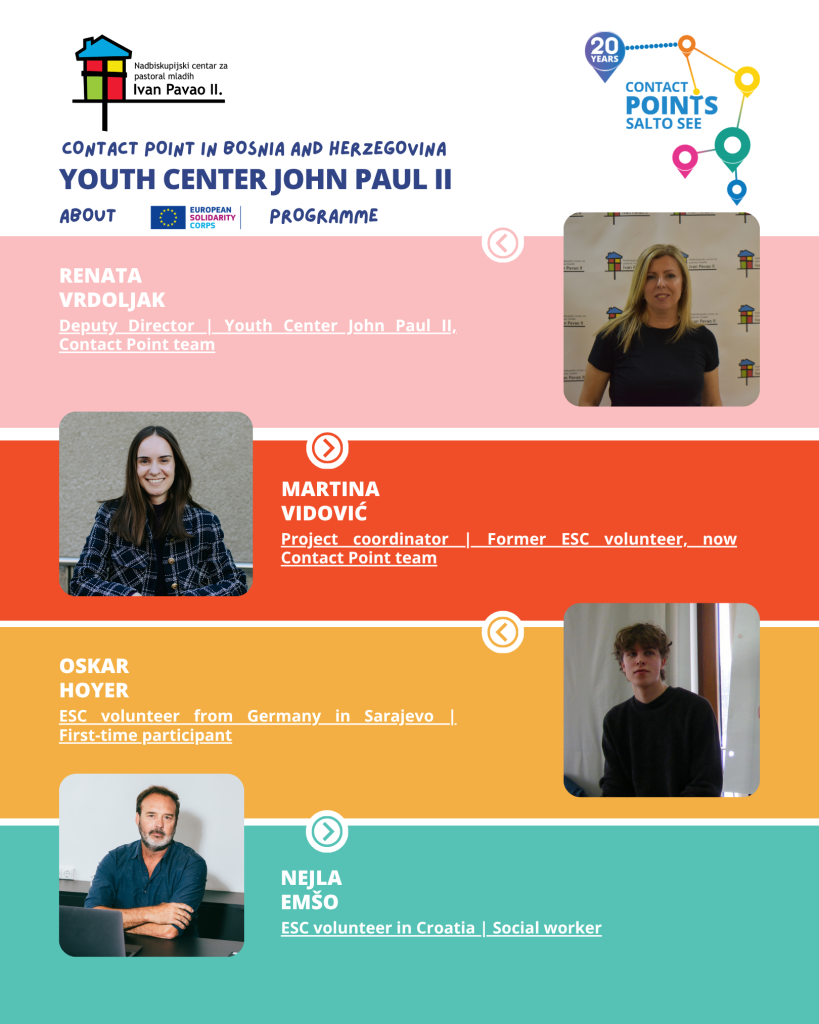
Youth Center John Paul II (NCMIP) has been opening doors to Europe for young people in Bosnia and Herzegovina for 18 years. As an ESC Contact Point, the Centre particularly promotes the European Solidarity Corps (ESC), helping young people turn solidarity into real change. Through trust, support and local presence, ESC experiences become reality that empowers young people and strengthens communities.
🧑 Nejla Emšo – Profile 3 (Participant / Volunteer)
Nejla Emšo is a social worker from Sarajevo. She first heard about ESC through volunteers who came to her workplace. With the support of her sending organization, she went on a 10-month volunteering experience in Split, Croatia, where she gained new knowledge and skills, and developed awareness of herself and her challenges.
1. Could you briefly introduce yourself and share how you first came into contact with the SALTO network and the programmes it supports (Erasmus+/ESC)? What role did they play in your personal and professional development?
Hi,
My name is Nejla Emšo, and I come from Sarajevo, Bosnia and Herzegovina. While I was working as a social worker in Sarajevo, ESC volunteers from different countries used to come to our workplace, and that was the first time I heard about the opportunity of gaining international volunteering experience in another country. On my job I met a wonderful Polish girl, Anja, who helped me create a profile on the ESC website.
After that, I started exploring countries and cities where I could volunteer as a social worker and contribute with the knowledge I already had, helping those who truly need support.
My sending organization did a large part of the work to make it possible for me to go on ESC volunteering, especially handling all the paperwork and documentation. During my stay abroad, they helped me overcome different challenges and followed my growth and development throughout the 10 months I spent in Split, Croatia.
2. Take us back to the beginning – how did you first hear about Erasmus+ or ESC, and what made you decide to apply?
I heard about you through a friend, and that really impressed me at the time because I don’t think young people in Sarajevo are well informed about the ESC project. If they know anything, it is usually only about Erasmus.
I decided to apply to everything that interested me within my field, where I could help others and at the same time develop my own skills.
3. How did the Contact Point or sending organisation support you in that moment?
In a kind and humane way, with a lot of understanding and genuine support. What I realized during my time abroad, while participating in a project like ESC in another country, is how important the sending organization is and how valuable their support is—knowing that I can always call Martina from (NCMIP) whenever I need something, I just know that she will handle it.
4. If you had to describe your experience with the CP or the sending organisation in a few words what would you say?
The experience with sending organization was very positive, as they were able to find common ground and solutions that were best for me.
5. Which moment during the programme most clearly showed you the value of the experience, and why?
Every experience is valuable and has its own advantages. Experiences build and shape us throughout life. After five months of volunteering, I realized that I needed to give myself a little rest. I was always aware that during the program I was learning, but also that the people around me, whom I influence, were learning as well, and I think that has always been the most valuable experience for me.
6. What changed for you professionally, and what changed personally, after participating in the programme?
Professionally, I developed myself further by learning and by approaching problems in a way that allows me to find the ideal solution. Personally, I developed a new way of recognizing negative people and distancing myself from them in time, as well as creating boundaries and filters in relationships to protect myself as an individual.
7. Is there something you are doing today, or a version of yourself you’ve become, that wouldn’t exist without this opportunity?
Today, I am a social worker. I joined this program as a very calm and composed person, and I’m glad that I have become more self-aware of the problems I have, because now I approach them differently.
8. Imagine your best friend is unsure about applying. What would you tell them from the heart?
What I always advise my friends in any situation is if they want to join this program just to escape their city, life problems, or themselves, thinking that going to another country will not solve their issues. Running away won’t solve anything, because our soul and habits follow us wherever we go – in the end, we are still ourselves.
Only if you want to get new skills, new experiences, explore another culture, and are ready to adapt to that culture and respect it with all your heart. If you want to meet new people and experience their daily lives, even if they are very different from your own, then it’s a true adventure – that’s when you can and should try the ESC life and program.
🧑 Oskar Hoyer – Profile 3 (Participant / Volunteer)
Oskar Hoyer is a 19-year-old volunteer from Germany, currently on an ESC project in Sarajevo. He first heard about ESC when a guest speaker visited his school. This was the first major decision he made on his own, and he hasn’t regretted it. The experience has made him more relaxed, confident and independent.
1. Could you briefly introduce yourself and share how you first came into contact with the SALTO network and the programmes it supports (Erasmus+/ESC)? What role did they play in your personal and professional development?
My name is Oskar. I am 19 years old, from Germany. Right now, I am in Sarajevo working as a European Solidarity Corps volunteer at the Youth Centre “John Paul II”. I first came across the SALTO network and programmes like Erasmus+ and the European Solidarity Corps when an external speaker visited my school and presented options for after the Abitur. One of them was a volunteering opportunity abroad, which immediately caught my interest. Later, I researched on my own and found the ESC.
Personally, it was a big step because it was the first major decision I made completely on my own, and I’ve dont regretted it.
2. How did you first hear about Erasmus+ or ESC, and why did you decide to apply?
As I said, it was promoted at my school. After that, I came across a sending organisation that explained different volunteering opportunities. The ESC in particular stood out because it offered many possibilities and good support, so I decided to apply.
3. How did the Contact Point or sending organisation support you at that moment?
I can only speak very positively about my sending organisation. I attended several multi-day meetings where I could first just observe and get a feel for things. Later, I received step-by-step guidance throughout the entire process, from deciding whether to do a volunteering programme at all to choosing the project and area. I never felt left on my own.
4. If you had to describe your experience with the Contact Point or sending organisation in a few words, what would you say?
Open, non-pressuring, and very supportive.
5. Which moment during the programme most clearly showed you the value of the experience, and why?
My programme isn’t finished yet, but I already see its value. Leaving my home environment and country has been personally very enriching, and interacting with people from different social backgrounds, including people with disabilities or young people from other countries, gives experiences I wouldn’t have in everyday life. That makes the programme incredibly valuable.
6. What changed for you professionally and personally after participating in the programme?
Professionally, it has strengthened my desire to work with young people in the future, even if in a different context as I do it right now in my project. Personally, I’ve become more relaxed and confident. I’m responsible for myself, structure my own days, and live the way I choose. This independence has been very empowering.
7. Is there something you are doing today, or a version of yourself you’ve become, that wouldn’t exist without this opportunity?
Definitely. I feel more independent, confident, and capable of making my own decisions.
8. Imagine your best friend is unsure about applying. What would you tell them from the heart?
I’d tell them to go for it. It’s a chance to grow, meet new people, and discover what you’re capable of, without any pressure and the help of an organisation. Even if it feels challenging at first, the experience is incredibly rewarding and can really shape who you are.
🧑 Martina Vidović – Profile 2 (Professional / Coordinator)
Martina Vidović works as a project coordinator at the Youth Centre “John Paul II” in Sarajevo, where she is also the contact person for the ESC Contact Point. Her first encounter with the programme was as an ESC volunteer (generation 2018/2019), after which she continued working at the Centre. Today she coordinates the work of ESC volunteers and works closely with the SALTO network.
1. Could you briefly introduce yourself and describe your professional journey in connection with the SALTO network and its programmes? How did you move from your first contact with the programmes to actively working with them today?
My name is Martina Vidović, I am currently working in the Youth Centre “John Paul II” in Sarajevo as a project coordinator. Among its many activities, the Youth Centre serves as the Contact Point for the European Solidarity Corps in Bosnia and Herzegovina, and within my role, I also act as a contact person for the ESC Contact Point.
My first encounter with the programme was as an ESC volunteer (generation 2018/2019). After being involved as a local volunteer at the Youth Centre, I had the opportunity to spend one year volunteering with a student organisation in Germany, with the Youth Centre acting as my sending organisation.
This experience also introduced me to the SALTO network, particularly through participation in the Annual Event for Returned ESC Volunteers. It was an important moment that deepened my understanding of the programme and the wider support structures behind it.
After completing my ESC project, I returned to Bosnia and Herzegovina and, a year later, started working at the Youth Centre as a coordinator. From the very beginning, I became actively involved in SALTO- related activities, initially through the organisation’s application for the Quality Label, and later through participation in various SALTO trainings and events. I also coordinate the work of our ESC volunteers, both those hosted by our organisation and those we support as a sending organisation.
Today, in my role as a contact person for the ESC Contact Point in Bosnia and Herzegovina, I work closely with the SALTO network and the wider Contact Point network, supporting the implementation and promotion of the programme.
2. How did you first come into contact with Erasmus+ or ESC, and what role did the CP play in that process?
I first came into contact with the European Solidarity Corps and Erasmus+ through my involvement as a local volunteer at the Youth Centre “John Paul II” in Sarajevo. At that time, the Centre was already actively engaged in the programmes and played an important role in promoting volunteering opportunities among young people. Through this engagement, I learned about the possibility to volunteer abroad and decided to apply for an ESC project in Germany, with the Youth Centre acting as my sending organisation. Although at that stage I was not directly aware of all the structures behind the programme, including the Contact Point network, I benefited from its work through the support and quality of the overall process. Looking back, this initial experience not only introduced me to the programme but also shaped my further professional path.
3. What did the CP help you understand or overcome when you were just starting?
When we were just starting as a new Contact Point for the European Solidarity Corps in Bosnia and Herzegovina, the CP network played a crucial role in helping us navigate this new responsibility. Although the Youth Centre already had extensive experience in volunteering management, especially within ESC projects, stepping into the role of a Contact Point brought new challenges, particularly in terms of understanding the broader structure of the programme, coordination at the international level, and our role within the network. The CP network, together with SALTO, provided strong and continuous support from the very beginning. We were warmly welcomed as a new Contact Point in the Western Balkans region, which made the onboarding process much easier. Through regular communication, meetings, and shared resources, we were able to better understand our responsibilities, exchange practices, and feel confident in our new role. This support helped us not only to overcome initial uncertainties but also to become an active and engaged member of the network.
4. Can you share an example of a project or initiative that would not have been possible without the CP’s support?
One concrete example would be the coordination and support of ESC volunteering projects implemented by our organisation. While the Youth Centre already had experience in volunteering, the role of the Contact Point and the support from the CP network were essential in ensuring the quality and visibility of these opportunities. Through the CP network and SALTO support, we had access to up- to-date information, guidelines, and good practices, which helped us better support both sending and hosting processes. This was particularly important when working with new organisations or volunteers who were not yet familiar with the programme.
5. In what ways have Erasmus+ and ESC influenced your professional path or the way you work today?
As a former ESC volunteer, the programme has had a significant impact on my professional path and the way I work today. I applied shortly after finishing university, and that experience became a key starting point for my career. As an international volunteer in Germany, I improved my language skills and gained valuable intercultural experience by living and working in a different environment. I also had the opportunity to be actively involved in organising youth activities and projects, which helped me develop practical skills in teamwork, communication, and project coordination. These experiences were very important for my later professional engagement, and I often say that they ultimately led me to the position I hold today.In my current role at the Youth Centre, I apply many of the competencies I developed during my ESC experience, especially when working with volunteers, supporting international projects, and promoting the values of the programme.
6. What specific skills, knowledge, or networks do you use today thanks to these programmes?
As I mentioned before, I developed communication, language, and organizational skills during my ESC experience, which have been invaluable in my current role at the Youth Centre. I also strengthened my intercultural competences, learning how to work effectively with people from diverse backgrounds. Perhaps most importantly, beyond the knowledge and skills I gained, I had the opportunity to meet many different people and build a professional network that I continue to rely on today, through both my ESC volunteering and my ongoing work at the Youth Centre. This network has been a great support in exchanging good practices, collaborating on international projects, and staying connected with the wider youth mobility community.
7. When young people or organisations approach you for the first time, what are they usually curious or unsure about?
When young people or organisations approach us for the first time, they are usually curious about how they can get involved in the programmes. At the same time, they often feel unsure about their own capacities. Organisations frequently worry whether they have enough resources or experience to participate, while young people often take time to decide if they want to apply for an ESC project.
8. What would you say to young people and organisations in the Western Balkans who are still hesitant about getting involved?
I would definitely encourage young people and organisations in the Western Balkans to take the step and get involved in the programmes. For young people, these programmes offer so many benefits: the chance to travel, expand their personal and professional networks, and learn new skills. For organisations, participating in ESC projects is also a valuable learning experience.
At the Youth Centre, we have learned a great deal through working with volunteers. It is always a new adventure for us as well, but we are always excited to provide young people with the opportunity to strengthen their competences and explore new opportunities. In addition, the support offered by SALTO and the Contact Point network is a valuable resource for both young people and organisations. Taking advantage of this support allows us to learn together and create better opportunities for everyone in the Western Balkans.
🧑 Renata Vrdoljak – Profile 1 (Strategic / Senior Voice)
Renata Vrdoljak is Deputy Director of the Youth Centre “John Paul II”, an organization dedicated to empowering young people through educational, volunteer, creative, social, and spiritual projects. Her work is focused on developing programmes that create space for young people to grow, engage in dialogue, and actively participate in society.
1. Could you briefly introduce yourself, describe your role within your organisation, and explain your connection with the SALTO network and the programmes implemented through it? How have you contributed to the development of organisations, young people, and the youth sector in your country through these programmes?
My name is Renata, and I work as the Deputy Director in an organization dedicated to empowering young people through educational, volunteer, creative, social, and spiritual projects. My work is focused on developing programs that create space for young people to grow, engage in dialogue, and actively participate in society.
Through our work, we are strongly connected to the SALTO-YOUTH network as well as the Erasmus+ and European Solidarity Corps programmes. As a Contact Point, we strive to be a bridge between young people, organizations, and international opportunities – a place where ideas receive support, partnerships are formed, and young people are encouraged to step beyond local boundaries and become part of a broader European community.
2. Looking back, how would you describe youth work and international cooperation in your country before, and how does it look today thanks to the SALTO network and the CPs?
Looking back, international cooperation for many organizations used to be more of an exception than a rule. There was a willingness, but often there was not enough information, contacts, or confidence to take the first step. Information was harder to access and scattered, opportunities were limited, and many organizations did not have sufficient experience or networks to engage in international projects. Many young people were not even aware that such opportunities existed.
Today, the situation is significantly different. Thanks to the SALTO-YOUTH network and the work of Contact Points, international cooperation has become more accessible, visible, and stronger. Organizations are connected, have greater support, and it is easier to access information; knowledge is shared, and young people are increasingly becoming active participants in international projects. This has significantly contributed to the professionalization of youth work and greater involvement of young people in international activities. What once felt distant and difficult to access is today a real opportunity for many young people.
3. How has the Contact Point concretely contributed to the development of your organisation and the youth sector in your country?
The Contact Point brings something extremely valuable to youth work – connectivity. And when it comes to international connectivity, that connection becomes even more valuable. Through information sharing, training, and networking, organizations gain not only access to information but also the confidence to step into international cooperation.
Programs such as Erasmus+ and the European Solidarity Corps have opened the door to new ideas, partnerships, and projects. This has not only increased the number of projects but has also changed the way organizations think about their work – with greater ambition, a stronger international perspective, and a deeper sense of belonging to a wider community.
4. What is the most significant change that Erasmus+ and ESC have brought to young people and organisations with the support of the CP?
As I have already mentioned above, the most significant change and value is international connectivity, or in other words, increased accessibility of international opportunities for young people. The biggest change is perhaps the simplest, but also the deepest – young people have started to believe that they have a place in Europe and in the world.
Through programs such as Erasmus+ and the European Solidarity Corps, young people have the opportunity to travel, learn, volunteer, and meet people from different cultures. Such experiences do not only change their CVs – they change the way they see themselves, other people, and their own future.
5. Can you share one concrete example where the CP made a real difference for a community and organisation?
During our relatively short period of acting as a Contact Point, we have already had several organizations reach out to us regarding applications for the Quality Label (QL) accreditation. We notice that the very fact that there is a place they can turn to already makes a significant difference, as organizations have the opportunity to receive concrete advice and guidance from those who have already gone through the process.
In this way, the presence of the Contact Point network in the Western Balkans represents an important resource and a real added value for organizations, as it facilitates their entry into international programs and strengthens their confidence throughout the process.
6. Why does it matter to have a local Contact Point – someone people can talk to, ask questions, and rely on?
Large international initiatives can sometimes feel distant or complex. That is precisely why the role of a local Contact Point is so important – a person or team who understands the local context and can bring these opportunities closer to people. People often need someone who understands their environment, their way of thinking, and even their language, and who can help them access information and opportunities more easily. Such support increases the trust and motivation of both organizations and young people to engage in international programmes.
A Contact Point is not only a source of information. It is also support, encouragement, and often the first step that gives organizations and young people the feeling that these international opportunities are truly accessible to them.
7. If you had to describe the importance of the CP network for the Western Balkans in one sentence, what would you say?
The Contact Point network for the Western Balkans shows that cooperation, solidarity, and the exchange of ideas can overcome borders and open up space for young people to build a shared European future.
8. Looking ahead, what would you love to see the CP network achieve in the next 20 years?
In the next 20 years, I would like to see generations of young people who have grown up with international cooperation as something natural – generations that actively participate in international projects, exchange knowledge, and work together to address social challenges.
I also hope that more and more young people will have the opportunity to take part in programs such as Erasmus+ and the European Solidarity Corps, regardless of which part of the region they come from.
I hope that the network will continue to expand opportunities, build partnerships, and inspire new organizations and young people to create projects that bring positive change to their communities and beyond.
🌐 Contact (Meta & Instagram): Nadbiskupijski centar za pastoral mladih “Ivan Pavao II.” / centar_za_mlade_ivan_pavao