


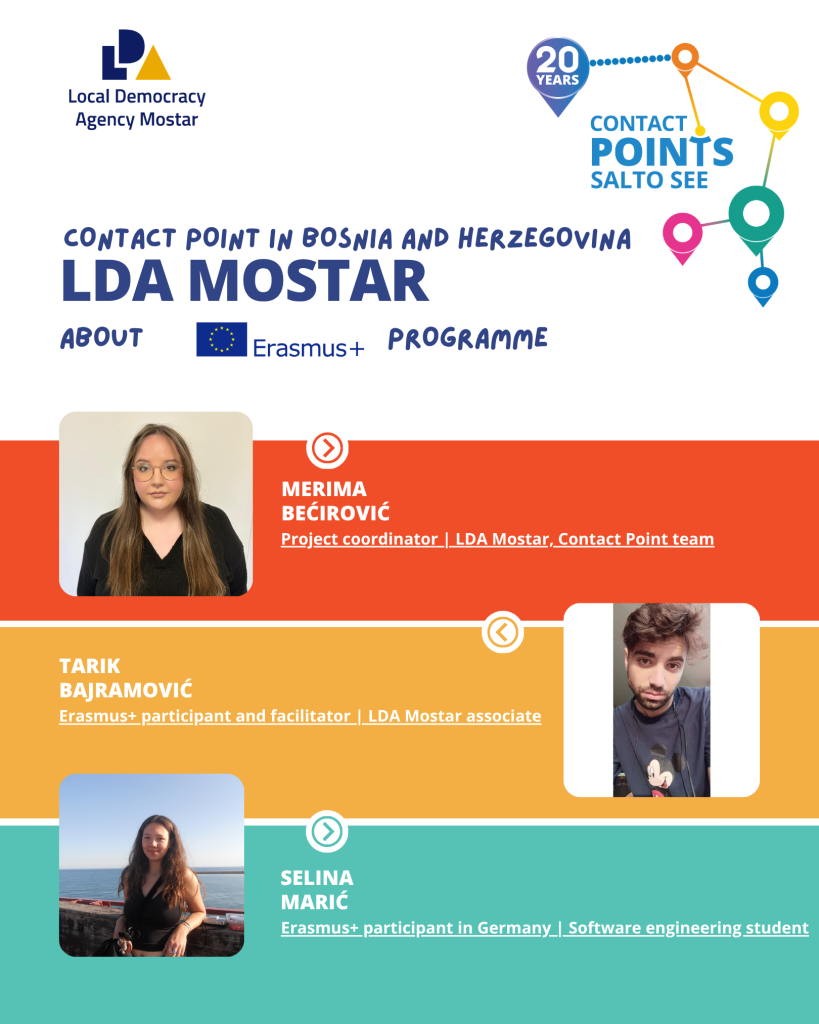
LDA Mostar is part of the Local Democracy Agencies network founded in 1993 as an initiative of the Council of Europe. Since October 2025, it serves as a SALTO SEE Contact Point, with a democratic tradition spanning over two decades. Their mission is to build bridges of cooperation among people, organizations and institutions, and to support young people and organizations in accessing European opportunities.
🧑 Selina Marić – Profile 3 (Participant / Volunteer)
Selina Marić is a software engineering student who applied to her first Erasmus+ programme in her first year of studies. Through LDA Mostar, she gained the confidence to see herself in an international setting, which later helped her apply for a semester abroad. Today she is more open, more confident in herself and her future aspirations.
1. Could you briefly introduce yourself and share how you first came into contact with the LDA Mostar and Erasmus+ programme? What role did they play in your personal and professional development?
My name is Selina; I am a software engineering student and in my first year I decided to apply to my first ever Erasmus+ exchange programme. That is when I first became acquainted with LDA Mostar. I have to say that their role in both my personal and professional development was crucial. Through their projects I managed to enhance my English conversational skills, working in groups, understanding different viewpoints and different cultures. They helped me break out of my bubble, realize my own strengths and work on my weaknesses.
2. Take us back to the beginning – how did you first hear about Erasmus+, and what made you decide to apply?
My friend sent me the link to a project called Pirouette that was held in Berlin, Germany and where LDA Mostar was one of the participant NGOs. After some pondering about if the project was really something I could do, and with some encouragement from my friend, I decided to push myself out of my comfort zone and applied. She had already participated in Erasmus+ projects before and from her stories I realized this was something that could only boost my life in every sense and that it was worth giving it a try.
3. How did LDA Mostar support you in that moment?
LDA Mostar was all the support I needed. The moment I was accepted I was contacted by an LDA team member, and they explained the whole process to me. I then went to the office where I met the rest of the team, and they helped me with all my questions. During the mobility, they were there any time I needed help and provided me with so much support. They helped me with my English, with adjusting to the long and exhausting travel time and with understanding the way project was going to go.
4. If you had to describe your experience with LDA Mostar in a few words what would you say?
Lifechanging. From my first experience with LDA to my latest one it has only changed my life for the better. It is interesting, fun and enriching.
5. Which moment during the E+ programme most clearly showed you the value of the experience, and why?
When I made my first international friendship. I have always wanted to meet people from other cultures and now I realize that Erasmus is the best way to do it. Today I have amazing friends from three different continents, something I could only have because of Erasmus and the opportunities that LDA Mostar has given me.
6. What changed for you professionally, and what changed personally, after participating in the programme?
The programme gave me the confidence to see myself in an international setting. That later helped me to apply for my semester abroad, which was truly a turning point in my professional life.
7. Is there something you are doing today, or a version of yourself you’ve become, that wouldn’t exist without this opportunity?
I am much more open to new ideas and experiences. I see the world from a few different angles now. This new version of me is well traveled and much more secure in what she wants for her future.
8. Imagine your best friend is unsure about applying. What would you tell them from the heart?
Every new experience is frightening, but that is the beauty of it. You can never meet your true self if you are stuck in the ordinary. Your true potential lives beyond what is familiar. With the support of LDA Mostar during the whole process, it truly is an opportunity that can’t be missed.
🧑 Tarik Bajramović – Profile 2 (Professional / Operator)
Tarik Bajramović is a long-time associate of LDA Mostar. His first experience with LDA was through the project “Let’s Debate Change” as an assistant coach. Since then, he has continued his collaboration, participating in various projects. Today he recognizes the importance of structural engagement of young people and promotes Erasmus+ as a tool for personal and professional growth.
1. Could you briefly introduce yourself and describe your professional journey in connection with the Erasmus+ programme at LDA Mostar? How did you move from your first contact with the programmes to actively working with them today?
Well, my first experience came from my first contact with LDA (Agency of local democracy) in Mostar. I took part in one of the projects (Lets Debate Change) as an assistant “coach” and our relationship went on from there. They invited me to take part in other projects as well (as a participant) and it our connection is growing strong.
2. How did you first come into contact with Erasmus+, and what role did the LDA Mostar play in that process?
The Erasmus+ project I encountered and took part in was the Pirouette project which encourages social engagement through art. I started as a participant but also took part in leading some of the workshops due to my artistic background in Mostar Puppet Theatre.
3. What did the LDA Mostar help you understand or overcome when you were just starting?
They helped me a lot with understanding the process of application for a project. I was not do familiar with such methodology before and LDA Mostar helped guide me to understanding how to create and implement an idea under the umbrella of administration.
4. Can you share an example of a project or initiative that would not have been possible without the LDA Mostar’s support?
For sure, the Pirouette project (although ran by a network of organisations) is deeply impacted by LDA Mostar people who took to great lenghts to ensure that everything is running smoothly from a logistic and creative perspective.
5. In what ways have Erasmus+ influenced your professional path or the way you work today?
Any productive work is a great addition to a person’s CV, and therefore it opened up opportunities for me that I am interested in.
6. What specific skills, knowledge, or networks do you use today thanks to these programme?
As i mentioned already, project application is an important skill I developed through my work with LDA and Erasmus+. I would like to mention the organisational part of workshops that I, before my work with LDA, never gave much thought. I know realise the importance of it.
7. When young people or organisations approach you for the first time, what are they usually curious or unsure about?
In my experience, young people are sceptic towards the importance of such project and might believe they are wasting their time. Also, there is a repetitiveness of project topics and also locations of project implementation. They feel like they are doing the same thing over and over again.
8. What would you say to young people and organisations in the Western Balkans who are still hesitant about getting involved?
It’s important for young people to direct their energy into something structural. It helps their CV, expands their network, even allows them to travel which is of large significance to shaping of identities that will, hopefully, become torch carriers of intelectual though in their local communities.
🧑 Merima Bećirović – Profile 1 (Strategic / Senior Voice)
Merima Bećirović is a Project Coordinator at LDA Mostar, which serves as the Erasmus+ Youth Contact Point in Bosnia and Herzegovina. In this role, she works with youth organisations, institutions, and young people to increase their understanding of Erasmus+ opportunities, strengthen their project development capacities, and encourage international cooperation.
1. Could you briefly introduce yourself, describe your role within your organisation, and explain your connection with the SALTO network and the programmes implemented through it? How have you contributed to the development of organisations, young people, and the youth sector in your country through these programmes?
My name is Merima Bećirović, and I am a Project Coordinator at LDA Mostar, which serves as the Erasmus+ Youth Contact Point in Bosnia and Herzegovina. In this role, I work with youth organisations, institutions, and young people to increase their understanding of Erasmus+ opportunities, strengthen their project development capacities, and encourage international cooperation.
Through information sessions, consultations, and continuous guidance, we help organisations transform ideas into quality projects and support young people in accessing European learning and mobility opportunities.
2. Looking back, how would you describe youth work and international cooperation in your country before, and how does it look today thanks to the SALTO network and the CPs?
In the past, youth work and international cooperation in Bosnia and Herzegovina were less structured and less accessible. Many organisations lacked information, confidence, and technical knowledge to engage in European programmes.
Today, thanks to the SALTO network and the support of Contact Points, the sector is more informed, more connected, and more capable. Organisations are stronger, partnerships are more strategic, and young people see international cooperation as an achievable opportunity rather than a distant concept.
3. How has the Contact Point concretely contributed to the development of your organisation and the youth sector in your country?
As a Erasmus+ Youth Contact Point in Bosnia and Herzegovina, we serve as a bridge between European programme frameworks and local realities. We simplify procedures, provide clarity, and offer practical support to first-time applicants. Our role is not only informational, but also empowering — we build confidence and capacity within the youth sector.
4. What is the most significant change that Erasmus+ have brought to young people and organisations with the support of the CP?
The most significant change is the growth of confidence and capacity within the youth sector. Young people no longer see international programmes as something distant or unreachable. They now feel capable of applying, managing, and implementing Erasmus+ projects, including Capacity Building in the field of Youth (CBY).
Beyond skills, there has been a clear mindset shift — from passive participation to active initiative. Organisations and young people are not only joining projects, but designing local initiatives, leading partnerships, and creating meaningful change in their communities.
5. Can you share one concrete example where the CP made a real difference for a community and organisation?
Although we have been part of the SALTO SEE CP network for only a few months, we have actively continued the mission of strengthening access to Erasmus+ opportunities in Bosnia and Herzegovina. During our tenure as the Erasmus+ Youth Contact Point, we have engaged a significant number of young people not only in local activities but also in international mobilities, supporting their personal and professional development.
A concrete example is the organisation of dedicated info days and hands-on sessions focused on the 2026 call for Capacity Building in the field of Youth (KA2). Representatives of institutions and organisations participated in practical workshops where they received step-by-step guidance on project development and application procedures. This direct support increased their confidence and technical capacity to apply independently and design impactful initiatives for their communities.
6. Why does it matter to have a local Contact Point – someone people can talk to, ask questions, and rely on?
A local Contact Point matters because accessibility builds trust. People need someone who understands their context, speaks their language, and is available for direct support. A CP reduces barriers and makes European opportunities feel realistic and achievable.
7. If you had to describe the importance of the CP network for the Western Balkans in one sentence, what would you say?
The CP network ensures that European opportunities are not abstract concepts, but real and accessible pathways for growth across the Western Balkans.
8. Looking ahead, what would you love to see the CP network achieve in the next 20 years?
In the next 20 years, I hope the CP network continues strengthening regional cooperation, expanding inclusion, and ensuring that every motivated young person and organisation — regardless of size or location — has equal access to Erasmus+ opportunities.
🌐 Contact (Website & Instagram): ldamostar.org / ldamostar