


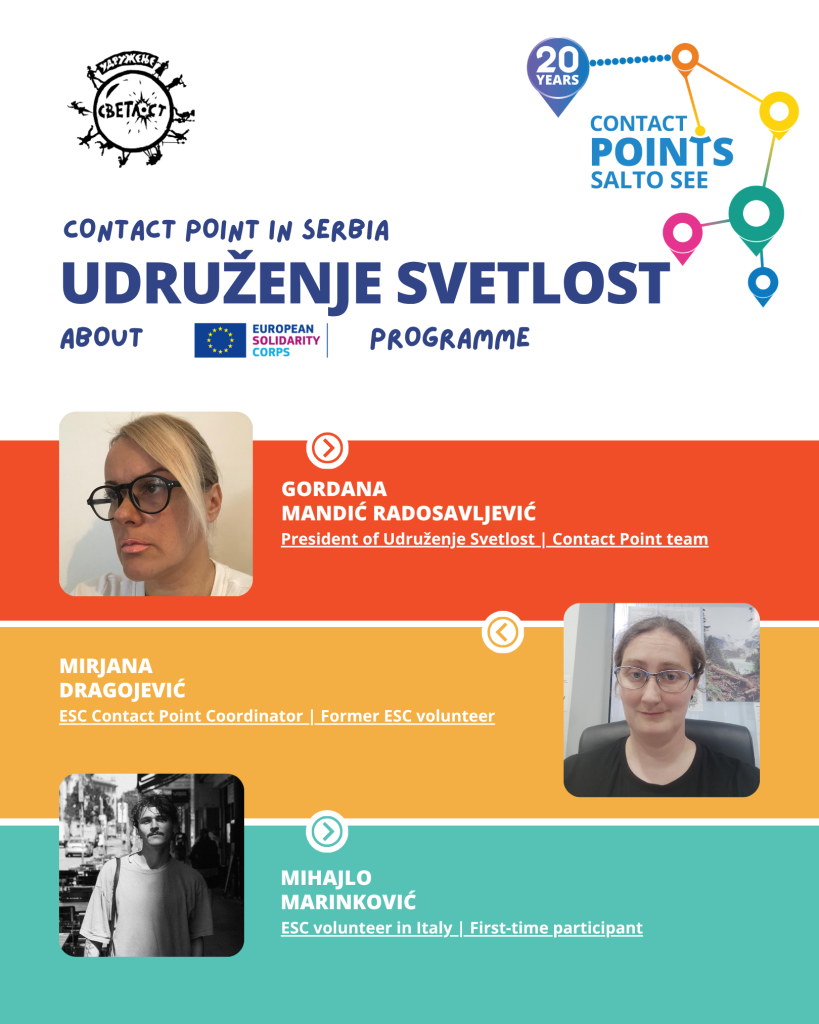
Udruženje Svetlost from Šabac was founded in 2001 and works on empowering young people through non-formal education, youth work, and international cooperation. The organization has extensive experience in international projects since 2005, starting with the Youth programme, through Youth in Action to Erasmus+ programmes. Since 2024, it serves as the ESC Contact Point for Serbia, actively promoting the programme to organisations, institutions and young people.
🧑 Mihajlo Marinković – Profile 3 (Participant / Volunteer)
Mihajlo Marinković is a 24-year-old from Šabac. Four years ago, he heard about Erasmus+ and ESC from a local volunteer. After his first exchange in Germany, he decided to go volunteering in Italy. The experience changed him for the better – it changed his perspective on life, brought him new friends, love, and a new outlook on the world.
1. Could you briefly introduce yourself and share how you first came into contact with the SALTO network and the programmes it supports (Erasmus+/ESC)? What role did they play in your personal and professional development?
My name is Mihajlo, I’m 24 years old, and I come from Šabac, a small city in Serbia. I first heard about salsa while I was in Italy on a volunteer project, but I never became interested in it afterward, so it didn’t play much of a role in my personal and professional development.
2. Take us back to the beginning – how did you first hear about Erasmus+ or ESC, and what made you decide to apply?
I first came into contact with ESC and Erasmus+ 4 years ago. I heard about youth exchanges from a local volunteer, as well as how it’s possible to participate in them by applying to an organization. A few months later, I went on my first exchange to Germany, and from that moment on, I became interested in this topic. On that project, I heard from participants in our group about the ESC and how it’s possible to go to another country to volunteer for 2 to 12 months, so after that project, I decided to go volunteer in Italy.
3. How did the Contact Point or sending organisation support you in that moment?
The organization that sent me on the ESC project was very supportive from the very beginning; They helped me with everything I needed for the application, as well as after my departure. During the first few weeks, we communicated frequently about my stay there, and every three months I wrote about the past period and the experiences I had. So I can say they supported me to the fullest.
4. If you had to describe your experience with the CP or the sending organisation in a few words what would you say?
After volunteering, I continued to collaborate with the organization. After the project, I worked on a lot of projects; I’d say we get along pretty well.
5. Which moment during the programme most clearly showed you the value of the experience, and why?
I would call it language learning. I think it’s a really good opportunity to learn a new language. For me personally, it meant a lot, especially when I started speaking it at a good level. In a way, the language itself helped me understand a lot of things about myself, not just to communicate with people. During the project, I made a lot of friends who I’m still in touch with and collaborate with today, and I believe it’s all thanks to the language.
6. What changed for you professionally, and what changed personally, after participating in the programme?
Personally, my perspective on reality changed; I realized that life can be very beautiful and that you can have wonderful experiences only if you’re curious. I left because I wanted to see something new and have new experiences. The project changed me for the better, and I will never look at life the same way again.
7. Is there something you are doing today, or a version of yourself you’ve become, that wouldn’t exist without this opportunity?
Of course, I’ve remained very close to the town where I used to live, and I often go back there, work with people there, and have a lot of friends there. I’m also in a relationship with a girl from that town, and the two of us are building something beautiful together. So I can say that the life I’m living today definitely wouldn’t exist without the project.
8. Imagine your best friend is unsure about applying. What would you tell them from the heart?
First, I would tell him about an experience I had, and then I would ask him to reflect on my experience and imagine himself somewhere in another country, learning a new language and having new experiences—and then I believe he would motivate himself.
🧑 Mirjana Dragojević – Profile 2 (Professional / Coordinator)
Mirjana Dragojević is the ESC Contact Point Coordinator for Serbia. Her journey began as an EVS and ESC volunteer, and today she coordinates the entire national support system. Through her work, she helps organizations and young people overcome administrative barriers and realize their projects.
1. Could you briefly introduce yourself and describe your professional journey in connection with the SALTO network and its programmes? How did you move from your first contact with the programmes to actively working with them today?
My name is Mirjana Dragojević and I am Contact Point Coordinator for ESC program in Serbia, but my journey started exactly where many of our young applicants are right now—living the experience firsthand. I was an EVS and ESC volunteer myself, sitting in those workshops, navigating a new culture, and learning on the ground. That experience completely rewrote my life.
I went from packing my bags as a volunteer, to organizing projects locally, and finally to coordinating the entire national support system. Throughout this whole evolution, SALTO wasn’t just a resource; it was the professional community that gave me my footing. Because I lived it myself, I know exactly what our volunteers and organizations need at every single stage of the process.
2. How did you first come into contact with Erasmus+ or ESC, and what role did the CP play in that process?
I first stumbled into this world through Udruženje Svetlost, and back then since it was Youth in Action, everything felt incredibly new, vast, and honestly, a bit out of reach. They didn’t just point me to a website; they helped me map out what opportunities actually matched my potential, showing me a clear doorway into a wider European space that I didn’t even know existed. The Contact Point played a massive role right at the start because they acted as the translator of the ESC program.
3. What did the CP help you understand or overcome when you were just starting?
When you are just starting out, the sheer volume of information can paralyze you—the application rules, the quality standards, the expectations. I had a lot of moments of uncertainty. The Contact Point helped me overcome that initial chaos by turning it into a structured, predictable process. Looking back now as the coordinator, I see how that pivotal support helped me realize that quality standards weren’t there to block my ideas, but to protect the experience. They stripped away the fear of the administrative hurdle.
4. Can you share an example of a project or initiative that would not have been possible without the CP’s support?
There isn’t just one project; it’s an entire chain of support that wouldn’t exist without the Contact Point. A perfect example was our Partnership Building Activity (PBA) organized alongside SALTO SEE, which brought together organizations from Italy and Serbia in Šabac, Serbia. That initiative directly birthed powerful new partnerships and fresh volunteering projects. We back up the ground with hands-on workshops to help them write their Quality Label applications. And our support doesn’t stop when they get approved. When organizations approach us asking, ‘We have the Quality Label, now what do we do?’—we are there to guide them through the actual implementation. The CP doesn’t just fund an event; we build the entire pipeline from a first international handshake to a fully operating volunteer project.
5. In what ways have Erasmus+ and ESC influenced your professional path or the way you work today?
These programmes completely redefined my understanding of what a career could look like. Before I got involved, my perspective on work was quite traditional and mostly confined to a local context. Erasmus+ and the ESC completely shattered that ceiling. They pushed me into a space where international collaboration, intercultural agility, and non-formal education are the standard, not the exception.
Today, because I’ve stood in the shoes of a volunteer, a project organizer, and now a national coordinator, the way I work is deeply relational. I don’t just see milestones and administrative deadlines; I look at every single process through the lens of quality and human impact. It taught me to design environments where people feel safe enough to take risks, step out of their comfort zones, and grow—because that’s exactly what these programmes did for me.
6. What specific skills, knowledge, or networks do you use today thanks to these programmes?
On the skills side, it’s advanced group facilitation, non-formal education methodologies, and cross-cultural communication—knowing how to bridge gaps between people from completely different backgrounds. In terms of knowledge, I rely on a deep understanding of European project management cycles, quality standards, and how to adapt complex institutional policies into practical tools for grassroots organizations. But the most valuable asset is the network itself. Thanks to SALTO and these programmes, my network isn’t just a collection of email addresses or a static contact list; it’s a living, breathing community of European colleagues, trainers, and organizations. Whether I need to brainstorm a new methodology, troubleshoot a crisis, or build a fresh partnership between countries like Serbia and Italy, I have a trusted circle of professionals across Europe just a phone call away.
7. When young people or organisations approach you for the first time, what are they usually curious or unsure about?
When organizations approach us for the first time, they are usually staring at the Quality Label application form and feeling completely overwhelmed. They get caught up in the phrasing, face a lot of confusion over what the specific questions are actually asking, and worry about how to fit their day-to-day activities into these formal European structures. They ask things like, ‘How do we prove our activities comply with the Quality Label standards?’ or ‘Are we interpreting this section correctly?’
They aren’t just looking for someone to check their spelling; they are looking for genuine advice and a sounding board. They need reassurance that their local work is valuable, and they need help translating their practical, grassroots ideas into the structured language of the application form without losing their original vision.
8. What would you say to young people and organisations in the Western Balkans who are still hesitant about getting involved?
I would look them straight in the eye and say: stop waiting until you feel 100% ready. If you wait until you know every single rule and have the entire map figured out, you will never take the first step. The reality of the Western Balkans is that we often suffer from imposter syndrome—we worry our organizations are too small, our English isn’t perfect, or that the bureaucracy is a wall we can’t climb.
But you don’t need to be an expert to start. The entire support system—the Contact Points, the workshops, the mentorship—is explicitly here to catch you, guide you, and turn that initial chaos into a clear path. This isn’t just about managing a budget or taking a trip; these programmes have the power to completely rewrite your personal identity and your professional career. If a former volunteer can end up coordinating the national network, imagine where your first step could take you. Just take the leap. We are right here waiting to help you build the bridge.
🧑 Gordana Mandić Radosavljević – Profile 1 (Strategic / Senior Voice)
Gordana Mandić Radosavljević is the President of Udruženje Svetlost and a project manager with over 20 years of experience in youth work and non-formal education. Her work is focused on empowering young people, especially those with fewer opportunities, through participation, mobility, and innovative learning methods.
1. Could you briefly introduce yourself, describe your role within your organisation, and explain your connection with the SALTO network and the programmes implemented through it? How have you contributed to the development of organisations, young people, and the youth sector in your country through these programmes?
I am Gordana Mandic Radosavljević the President of the organisation Udruženje Svetlost and a project manager with over 20 years of experience in youth work and non-formal education. My work has been focused on empowering young people, especially those with fewer opportunities, through participation, mobility, and innovative learning methods. Within my organisation, I coordinate the work in general which includes international projects under Erasmus+ and supporting my co-worker in promotion of the European Solidarity Corps. Over the years, I have been actively engaged with the SALTO network through trainings, partnership-building activities, etc. This connection has been essential for the development of our organisation. SALTO and the CP network have not only provided access to knowledge and partnerships, but have also strengthened our strategic role in the youth field. Through these programmes, we have been able to develop new methodologies, support young people in becoming active citizens, and contribute to strengthening the youth sector in Serbia and the region.
2. Looking back, how would you describe youth work and international cooperation in your country before, and how does it look today thanks to the SALTO network and the CPs?
Youth work in our country was much more fragmented, less structured, and with limited access to international cooperation opportunities. There were motivated organisations and individuals, but fewer resources, less visibility, and weaker connections to European networks. Today, thanks to Erasmus+, ESC, SALTO and the Contact Points, we see a completely different landscape. Youth work is more professional, more connected, and more inclusive. Organisations are better equipped, young people are more mobile and confident, and international cooperation has become a standard practice rather than an exception. The Contact Points have played a key role in this transformation. They have acted as a bridge between European opportunities and local realities – translating programmes into something accessible, understandable, and usable for organisations at the grassroots level.
3. How has the Contact Point concretely contributed to the development of your organisation and the youth sector in your country?
The Contact Point role have directly contributed to the development of our organisation by providing guidance, capacity-building opportunities, and continuous support in navigating ESC programme. SALTO SEE has helped us improve the quality of our youth work, build stronger partnerships, and better understand programme priorities.
At a broader level, it contributed in strengthening the youth sector by making European programmes more reachable for smaller organisations, especially those outside capital cities or without prior international experience.
4. What is the most significant change that Erasmus+ and ESC have brought to young people and organisations with the support of the CP?
The most significant change is accessibility and empowerment.
Erasmus+ and ESC have transformed young people from passive observers into active participants in society. Young people today are more confident, more mobile, and more aware of their potential to create change.
For organisations, the biggest change is professionalization and networking – we are no longer isolated, but part of a European ecosystem of cooperation.
5. Can you share one concrete example where the CP made a real difference for a community and organisation?
One concrete example of the impact of the Contact Point is how it helped us and many other organisations and individuals in Serbia to start actively using the opportunities within the European Solidarity Corps programme. Before this support, many local actors were aware of ESC only in a very general sense, but did not have the confidence or knowledge to apply and participate.
6. Why does it matter to have a local Contact Point – someone people can talk to, ask questions, and rely on?
Having Serbian Contact Point is essential because it brings Europe closer to Serbian people and communities. It is not just about information, it is about trust, guidance, and accessibility. People need someone they can ask, someone who understands both the programme and the local context. Contact Points make European programmes human, approachable, and possible.
7. If you had to describe the importance of the CP network for the Western Balkans in one sentence, what would you say?
The Contact Point network is the bridge that turns European opportunities into real local change, ensuring that no organisation and no young person is left behind.
8. Looking ahead, what would you love to see the CP network achieve in the next 20 years?
I imagine a system where every young person, regardless of where they live, can easily access opportunities, mentorship, and international cooperation. A EU society that is even more inclusive, digital, and responsive to emerging challenges such as mental health, climate change, and youth unemployment.
It will be preserved what makes this program truly valuable – human connection, trust, and the belief that young people are drivers of change, not just beneficiaries of programmes.
🌐 Contact (Website & Instagram): svetlost.org.rs / udruzenje.svetlost