


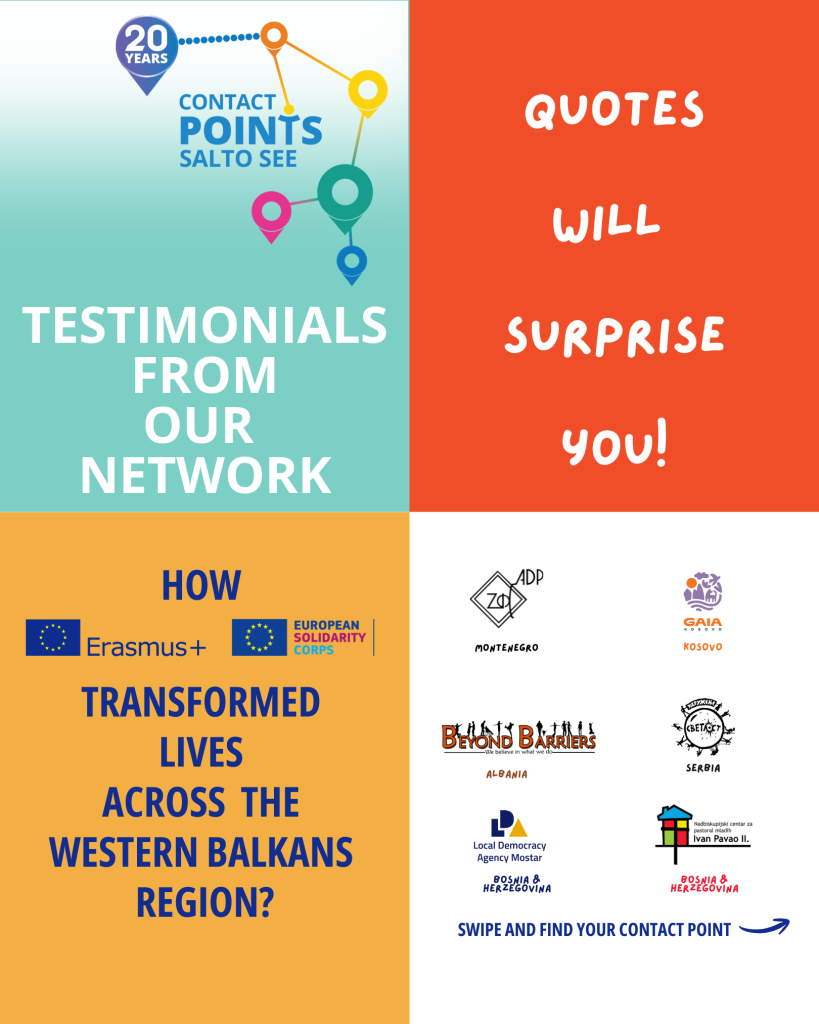
🇲🇪 ADP-ZID – Montenegro
ADP-ZID is a non-governmental organization founded in 1996 in Montenegro. Since 2006, it has been serving as a Contact Point for the Erasmus+ programme, and later for the European Solidarity Corps (ESC). Their vision is a society of equal and responsible citizens, oriented towards democracy, social values, and community development. Through participation, innovation, creativity and solidarity, they have been supporting young people, organizations and communities for over 15 years.
🧑 Katica Nišavić – Profile 3 (Participant / Volunteer)
Katica Nišavić is an artist from Montenegro who participated in an ESC project in Belgium, where she spent a year at an art residency. Her journey began in 2018 through the local organization FORUM MNE, and continued with the support of ADP-Zid.
1. Could you briefly introduce yourself and share how you first came into contact with the SALTO network and the programmes it supports (Erasmus+/ESC)? What role did they play in your personal and professional development?
It was in 2018, while I was involved in the local NGO FORUM MNE as an intern, that I first came into contact with the SALTO network. Shortly after, I attended a short-term project in Spain. In 2019, I spent a year in Belgium doing a long-term European Solidarity Corps project, which transformed me on many levels and had a lasting impact on who I am today.
2. Take us back to the beginning – how did you first hear about Erasmus+ or ESC, and what made you decide to apply?
I first heard about it from my sister, who did her ESC project in Croatia. I immediately became curious and motivated to do something similar. I started researching projects that matched my artistic interests and eventually found one at an art residency in Belgium.
3. How did the Contact Point or sending organisation support you in that moment?
My sending organisation was ADP ZID, and Mirela was the person I communicated with the most. They were very helpful throughout the entire process, from applying and handling visa procedures to organizing my travel to the country where I was going to carry out the project.
4. If you had to describe your experience with the CP or the sending organisation in a few words, what would you say?
I would describe it as understanding, empathetic, and supportive.
5. Which moment during the programme most clearly showed you the value of the experience, and why?
It was during the team-building activities with other volunteers I met throughout the projects. Their open-mindedness and inspiring eagerness for new experiences really showed me the true value of the programme.
6. What changed for you professionally, and what changed personally, after participating in the programme?
Professionally, it enriched me with photography knowledge and expanded both my hard and soft skills. Personally, it encouraged me to keep stepping out of my comfort zone whenever I have the opportunity.
7. Is there something you are doing today, or a version of yourself you’ve become, that wouldn’t exist without this opportunity?
Absolutely. One of my biggest dreams came true — I had my first solo photography exhibition, initially in Podgorica. Later, I was invited to Belgium, to the same art residency, to showcase my work there as well.
8. Imagine your best friend is unsure about applying. What would you tell them from the heart?
Step out of your comfort zone — you will never regret it. Be bold about what you want, and you won’t even be able to count all the benefits that will come from it.
🧑 Miloš Laković – Profile 2 (Professional / Educator)
Miloš Laković is a chemistry teacher in three schools in Montenegro and a dance instructor in Podgorica. Through Erasmus+ and ESC programmes, he improved his communication, organizational and teamwork skills, and today actively passes on his gained knowledge through work with young people.
1. Could you briefly introduce yourself and describe your professional journey in connection with the SALTO network and its programmes?
Hello, my name is Miloš Laković. I work as a chemistry teacher in three schools in Montenegro, and I am also a dance instructor in a dance school in Podgorica. My participation in SALTO programmes has contributed greatly to my professional and personal development. Through these experiences, I improved my communication skills, developed my personality, and strengthened my organisational and teamwork abilities.
2. How did you move from your first contact with the programmes to actively working with them today?
My first contact with the Erasmus+ and ESC programmes was through ADP-Zid, an organisation I had already been cooperating and volunteering with for some time. They became my contact point for an Erasmus project in Spain. Before my departure, they organised preparation meetings and training sessions, and after I returned, they also provided opportunities for me to lead workshops and share the knowledge and experiences I had gained. Following my Erasmus experience, I became involved in several other youth exchanges and international projects outside Montenegro.
3. How did you first come into contact with Erasmus+ or ESC, and what role did the CP play in that process?
The Contact Point encouraged me through various activities to participate in Erasmus+ projects and youth exchanges. They introduced me to how the programme works, explained the opportunities available, and gave me the motivation and support I needed before starting my Erasmus journey.
4. What did the CP help you understand or overcome when you were just starting?
The CP helped me understand how the programmes function and supported me throughout the entire process. Many of the activities and initiatives I organised after my exchanges would not have been possible without their support, resources, and promotion of the ideas I wanted to implement.
5. Can you share an example of a project or initiative that would not have been possible without the CP’s support?
All the activities I experienced through Erasmus+, including the preparation trainings, the programme itself, and the follow-up initiatives afterwards, helped me become more confident and develop many important skills. One of the biggest improvements was my language and communication skills, which later helped me start working in an international school environment.
6. In what ways have Erasmus+ and ESC influenced your professional path or the way you work today?
Erasmus+ and ESC have had a strong influence on both my professional and personal life. They helped me become more open-minded, adaptable, and confident when working with different groups of people. Today, I apply many of the methods, communication approaches, and organisational skills I learned through these programmes in my work as both a teacher and dance instructor.
7. What specific skills, knowledge, or networks do you use today thanks to these programmes?
Thanks to these programmes, I improved my communication and presentation skills, teamwork abilities, leadership, and project organisation. I also built an international network of friends and colleagues, which continues to open new opportunities for cooperation, learning, and professional growth.
8. When young people or organisations approach you for the first time, what are they usually curious or unsure about?
Young people are often unsure about how the time spent on these programmes will contribute to their personal and professional development. Many of them are students with university obligations, so they are also concerned about whether they will be able to balance all the programme activities with their studies and responsibilities.
9. What would you say to young people and organisations in the Western Balkans who are still hesitant about getting involved?
I would tell them not to overthink too much, but to give themselves a chance and be brave enough to join the programme. They will gain valuable experience that will help them grow both personally and professionally. The whole process, with all its challenges and successes, is exactly what makes these programmes special, and I am sure they will enjoy the journey.
🧑 Milena Šćepanović – Profile 1 (Strategic / Senior Voice)
Milena Šćepanović is a long-time member of ADP-Zid, where through various roles she has contributed to the development of youth work and international cooperation in Montenegro. Through her work with Erasmus+ and ESC programmes, as well as the SALTO network and Contact Point mechanisms, she has worked on empowering young people and organisations to become active participants in their communities.
1. Could you briefly introduce yourself, describe your role within your organisation, and explain your connection with the SALTO network and the programmes implemented through it? How have you contributed to the development of organisations, young people, and the youth sector in your country through these programmes?
My name is Milena Šćepanović and I have been part of ADP-Zid for many years, where through different roles I have had the opportunity to contribute to the development of youth work and international cooperation in Montenegro. Through my work, I have been closely connected with the Erasmus+ and ESC programmes, as well as with the SALTO network and Contact Point mechanisms that made these opportunities more accessible to young people and organisations in our region.
Over the years, through mobility projects, trainings, partnerships and support for organisations, we worked on empowering young people to become active participants in their communities, gain new knowledge, experiences and international connections. At the same time, we contributed to strengthening the capacities of civil society organisations and the professionalisation of youth work in Montenegro.
Through ADP-Zid and cooperation with the SALTO network, we had the opportunity to be part of a process that enabled many young people, often for the first time, to travel, learn, volunteer and believe that they can actively contribute to society.
2. Looking back, how would you describe youth work and international cooperation in your country before, and how does it look today thanks to the SALTO network and the CPs?
When we look back 20 or 30 years ago, youth work in Montenegro was much less recognised and developed than it is today. There was a lot of enthusiasm, but fewer opportunities, fewer international partnerships and limited access to programmes that would allow young people to learn, travel and connect with peers from other countries. Organisations often worked in isolation and with much less support for capacity building.
Today, the situation is significantly different, and I believe that SALTO and organisations acting as Contact Points have played a very important role in this change. Through these programmes, space was created for continuous international cooperation, exchange of knowledge and the professionalisation of youth work. Organisations have become stronger, more connected and more visible, while young people now have many more opportunities to participate in international projects, trainings, volunteering and decision-making processes.
The role of CPs in the Western Balkans has been especially important because they acted as a bridge between European programmes and local organisations and young people. People had someone they could turn to, ask questions, receive support and encouragement from. This contributed to international cooperation no longer being a privilege of a small number of organisations, but an opportunity accessible to a much wider circle of young people and organisations in the region.
3. How has the Contact Point concretely contributed to the development of your organisation and the youth sector in your country?
The Contact Point played a very important role in the development of our organisation, but also of the youth sector in Montenegro in general. Through continuous support, information sharing and mentoring, it enabled organisations to better understand Erasmus+ and the European Solidarity Corps programmes and gain the confidence to engage in international projects.
For ADP-Zid, which has been the Contact Point for the Erasmus+ programme since 2006, it was particularly significant that through cooperation with the CP we had access to quality information, trainings, partnerships and spaces for exchanging experiences with organisations from the region and across Europe. This contributed to strengthening our capacities, developing new youth programmes and creating long-term international cooperation.
On a broader level, the Contact Point contributed to youth work becoming more visible and recognised as an important part of social development. It encouraged many smaller and less developed organisations, as well as young people, to engage in different programmes even when they had no previous experience. This accessibility of support and the feeling that there was someone who understood the local context and organisations’ needs was crucial for the development of the entire sector.
4. What is the most significant change that Erasmus+ and ESC have brought to young people and organisations with the support of the CP?
I believe that the most significant change brought by Erasmus+ and ESC to young people and organisations is the opening of space for personal and professional development, but also the feeling of being part of a wider European community. Thanks to these programmes, young people had the opportunity to travel, meet other cultures, develop competencies and gain the confidence to actively contribute to their communities.
For many young people from Montenegro, this was their first international experience that changed their perspective, opened new friendships and professional opportunities. At the same time, organisations became stronger, more professional and more connected with partners across Europe through these programmes.
The support of the Contact Point was especially important because it made these opportunities more accessible and understandable to organisations and young people at the local level. The CP was not only an information service, but also a partner that provided support and a sense that organisations could successfully develop international projects and long-term cooperation.
5. Can you share one concrete example where the CP made a real difference for a community and organisation?
One concrete example where the Contact Point made a real difference was the support provided to smaller local organisations that had no previous experience with international projects. Through workshops, mentoring and direct support in project preparation, many of these organisations managed to participate in Erasmus+ programmes for the first time.
I remember one organisation from a smaller local community that had great motivation to work with young people, but lacked the knowledge and contacts needed to develop international projects. With the support of the CP, they managed to find partners, prepare a project and involve young people from their community in an international exchange. This experience changed not only the organisation, but also the young people themselves, who for the first time had the opportunity to travel, meet peers from other countries and gain new knowledge and self-confidence.
Such examples show how important local support is and how a Contact Point can become a driver of development for communities that otherwise might not have access to these opportunities.
6. Why does it matter to have a local Contact Point – someone people can talk to, ask questions, and rely on?
Because it means a lot to people to have someone they can directly turn to and speak with in their own language and within their own context. EU programmes can sometimes seem complicated, especially for organisations applying for the first time. A local CP makes these opportunities accessible, understandable and achievable.
It makes a huge difference when there is someone who understands the local realities, challenges and needs of organisations and who can guide them through the whole process.
I believe that this human aspect is one of the greatest values of the CP network. People do not only need programmes and administration — they also need support, trust and the feeling that they can rely on someone.
7. If you had to describe the importance of the CP network for the Western Balkans in one sentence, what would you say?
Creating space for young people from the region to learn, cooperate, travel and together build a more open and connected society.
8. Looking ahead, what would you love to see the CP network achieve in the next 20 years?
In the next 20 years, I would love to see the CP network continue to be a strong space of connection and support for organisations and young people in the Western Balkans, regardless of the fact that some countries may become members of the European Union in the meantime.
It is important not to lose the spirit of cooperation, solidarity and mutual understanding that has been built through these programmes over the years. I believe the CP network can play an even more important role in empowering young people to remain active in their communities, continue developing quality youth work and keep connecting the region through shared values, partnerships and learning opportunities.
🌐 Contact (Website & Instagram): zid.org.me / adpzid
🇦🇱 Beyond Barriers – Albania
Beyond Barriers Association (BBA) is a youth NGO in Albania dedicated to inclusion, empowerment, and equal opportunities for young people, founded in 2004. Since 2011, it has been serving as a Contact Point, working closely with the SALTO SEE network to promote Erasmus+ and ESC programmes across Albania and the region. Their mission is that Europe belongs to everyone, regardless of background, ability or identity.
🧑 Jon Kola – Profile 3 (Participant / Volunteer)
Jon Kola is a young man from Albania who first came into contact with the SALTO network through his work with Beyond Barriers Association. What started as a simple involvement quickly turned into a meaningful journey of learning, connecting, and growing within an inspiring international community.
1. Could you briefly introduce yourself and share how you first came into contact with the SALTO network and the programmes it supports (Erasmus+/ESC)? What role did they play in your personal and professional development?
I’m Jon, and I first got to know the SALTO network through my work with Beyond Barriers Association, the National Contact Point for Erasmus+ and the European Solidarity Corps in Albania. What started as a simple involvement quickly turned into a meaningful journey of learning, connecting, and growing within an inspiring international community.
I’m truly grateful to both SALTO and Beyond Barriers, as they have shaped not only my professional path but also the way I see youth engagement and inclusion. They gave me opportunities to learn, to contribute, and to feel part of something bigger across Europe.
2. Take us back to the beginning – how did you first hear about Erasmus+ or ESC, and what made you decide to apply?
I first heard about Erasmus+ and ESC through Beyond Barriers Association, and I was immediately curious about the opportunities it offered. The idea of meeting people from different cultures and working together on shared goals really stood out to me. I decided to apply because I wanted to step out of my comfort zone and experience something new, while also contributing to initiatives that create real impact for young people.
3. How did the Contact Point or sending organisation support you in that moment?
Beyond Barriers Association was there from the very beginning, making everything feel accessible and clear. They guided me through the application process, answered my questions and really encouraged me to take that first step. What made a difference was their constant support and belief in young people’s potential, it gave me the confidence to apply and fully engage with the opportunity.
4. If you had to describe your experience with the CP or the sending organisation in a few words what would you say?
Supportive, empowering and genuinely motivating. It felt like being guided by people who truly care about your growth and want to see you succeed.
5. Which moment during the programme most clearly showed you the value of the experience, and why?
One moment that really stayed with me was working closely with young people from different countries and realizing how similar our challenges and aspirations were. It made the whole experience feel real and meaningful, not just an exchange but a shared space for understanding and collaboration. That moment showed me the true value of the programme as it’s not only about skills or opportunities, but about building connections that change how you see both yourself and others.
6. What changed for you professionally, and what changed personally, after participating in the programme?
Professionally, the experience helped me build confidence, improve my communication skills and better understand how international projects and youth programmes actually work in practice. It gave me a clearer sense of direction and motivated me to stay engaged in this field.
Personally, it made me more open-minded and aware of different perspectives. I grew more confident in myself and more comfortable stepping into new environments and connecting with people from diverse backgrounds.
7. Is there something you are doing today, or a version of yourself you’ve become, that wouldn’t exist without this opportunity?
I don’t think I would be the same version of myself without this experience. It helped me become more confident, more engaged and more aware of the impact young people can have in their communities. Today, I’m someone who actively seeks opportunities to contribute, connect and lead. And that mindset really grew from this journey.
8. Imagine your best friend is unsure about applying. What would you tell them from the heart?
I’d tell them it’s completely normal to feel unsure, but that this kind of experience has a way of surprising you in the best possible way. You don’t need to have everything figured out before applying, what matters is being open to learning and stepping into something new. From the heart, I’d say it’s an opportunity that can really shape how you see yourself and the world, and sometimes the most meaningful growth starts right where you feel a bit uncertain.
🧑 Blertina Koka – Profile 2 (Professional / Manager)
Blertina Koka works as International Networks and Partnership Manager at the NGO Together for Life. Her journey with Erasmus+ and ESC programmes began 8 years ago, when as a youth coordinator she attended an info session organized by the Beyond Barriers team. Today she coordinates and manages projects funded by various EU programmes.
1. Could you briefly introduce yourself and describe your professional journey in connection with the SALTO network and its programmes? How did you move from your first contact with the programmes to actively working with them today?
My name is Blertina Koka, and I currently work as an International Networks and Partnership Manager at the NGO Together for Life. In my role, I coordinate and manage projects funded by different EU programmes.
My journey with these programmes started about 8 years ago, when I was working as a youth coordinator. I attended an information session organised by the Beyond Barriers team, where I was introduced for the first time to the SALTO network and opportunities like Erasmus+ and the European Solidarity Corps. That moment really opened a new perspective for me, I realised there were so many opportunities for young people to connect, learn, and gain experience across Europe.
Later, in 2022, I took part in the TOSCA certified training under the European Solidarity Corps, organised by the Austrian National Agency in cooperation with the Spanish National Agency. That experience helped me better understand volunteering systems, both hosting and sending, and marked an important step in my professional development.
2. How did you first come into contact with Erasmus+ or ESC, and what role did the CP play in that process?
My first real introduction came through that information session. The Contact Point played a key role in making these programmes understandable and accessible. Before that, these opportunities felt quite distant and unclear, but through their guidance, everything became more concrete and achievable.
3. What did the CP help you understand or overcome when you were just starting?
At the beginning, I didn’t fully realise how many opportunities existed (trainings, exchanges, volunteering, job shadowing). The CP helped clarify these pathways and showed us that these opportunities are actually open and reachable.
4. Can you share an example of a project or initiative that would not have been possible without the CP’s support?
CP has supported us continuously, from understanding the programmes to actually applying for them. Our team has regularly participated in their information sessions, especially when new calls were opening. But the biggest impact came when we coordinated our first Erasmus+ project as a lead organisation. At that stage, their support made the process considerably smoother.
5. In what ways have Erasmus+ and ESC influenced your professional path or the way you work today?
These programmes have played a major role in my development. I started as a participant in trainings, then gradually became a coordinator and host of activities. Today, our organisation has implemented dozens of projects, as both lead and partner, under programmes like Erasmus+ (CBY), Virtual Exchange, KA220-ADU, CERV, and more. Personally, this journey has helped me grow step by step, from attending activities to now designing and writing projects myself. It has completely shaped the way I work and the direction of my career.
6. What specific skills, knowledge, or networks do you use today thanks to these programmes?
Beyond technical knowledge, I’ve gained strong project management skills, international collaboration experience, and a valuable network of partners across Europe. These connections and experiences are something I use every day in my work, whether it’s building partnerships, developing new ideas, or implementing projects.
7. When young people or organisations approach you for the first time, what are they usually curious or unsure about?
One very common misconception is that you need personal connections to be selected. We’ve sent many young people from Albania abroad through these programmes, and some of them were genuinely surprised to be selected without “knowing someone.” This shows that there is still a lack of awareness, young people don’t always realise that these opportunities are based on merit, which often makes them hesitate to apply.
8. What would you say to young people and organisations in the Western Balkans who are still hesitant about getting involved?
I would say: take every opportunity you can for learning and growth. Even if you are still in school, try to find time to participate in trainings, exchanges, or volunteering activities. These experiences are incredibly valuable, not only professionally, but also personally. Don’t wait until you finish your studies, and focus only on paid work from the beginning. Start by gaining experience, getting involved, and exploring. It’s truly one of the best investments you can make in yourself.
🧑 Ana Mullanji – Profile 1 (Strategic / Senior Voice)
Ana Mullanji is the Executive Director of Beyond Barriers Association, an organisation she has led for over 22 years. Her work is deeply rooted in creating opportunities for young people, especially those often left out. As a Contact Point coordinator for Erasmus+ Youth and the European Solidarity Corps, she is closely connected to the SALTO SEE network, contributing to capacity building, quality strengthening, and shaping a more connected and resilient youth sector.
1. Could you briefly introduce yourself, describe your role within your organisation, and explain your connection with the SALTO network and the programmes implemented through it? How have you contributed to the development of organisations, young people, and the youth sector in your country through these programmes?
I am the Executive Director of Beyond Barriers Association, an organisation I have had the privilege to lead for more than 22 years. Over this time, my work has been deeply rooted in creating opportunities for young people, especially those who are often left out, to feel seen, heard, and empowered.
As a Contact Point coordinator for the Erasmus+ Youth and European Solidarity Corps programmes, I have been closely connected to the SALTO SEE network, contributing to building capacities, strengthening quality, and helping shape a more connected and resilient youth sector. For me, this role has never been just technical, it is about opening doors and walking alongside others as they step through them.
2. Looking back, how would you describe youth work and international cooperation in your country before, and how does it look today thanks to the SALTO network and the CPs?
Twenty years ago, youth work in Albania felt scattered and fragile. Opportunities were limited, and international cooperation was something only a few could access.
Today, the landscape is completely different. Through the support of the SALTO SEE and the Contact Point network, we see a sector that is more confident, more professional, and more connected.
What is most meaningful is that this change is not only structural, but also organisational. You can see it in the way organisations from our region plan strategically, build partnerships, and take ownership of their role within the wider European youth field.
3. How has the Contact Point concretely contributed to the development of your organisation and the youth sector in your country?
The Contact Point has been working “behind the scenes”, a quiet but powerful driver of change. When we started our work back in 2011, European programmes often felt distant, complex, and out of reach for many organisations.
Over time, the Contact Point helped bring these programs closer, making them more understandable, more accessible. The contact Point guides, mentors, encourages, and sometimes we simply reassure organisations that yes, they can do it. In that sense, our role has been to transform potential into participation, and hesitation into action.
4. What is the most significant change that Erasmus+ and ESC have brought to young people and organisations with the support of the CP?
The most significant change I have witnessed is a gradual shift in mindset, but this transformation has been collective. The realities of the youth sector and youth work in Albania have improved over time, supported by European programmes and the SALTO SEE, which have played a vital role in opening the sector to Europe. By creating opportunities to participate at European level, exchange practices, and build partnerships across the region, these programmes have strengthened the capacity and confidence of youth organisations.
Today, we see more organisations taking initiative, engaging in international cooperation, and contributing more actively to their communities. While challenges remain, there is a clear movement towards greater ownership and participation. For me, this gradual shift, from limited engagement towards more active involvement, is the real success story.
5. Can you share one concrete example where the CP made a real difference for a community and organisation?
I have seen small, local organisations, often with no previous international experience, take their first steps with a bit of guidance and belief.
Through Contact Point mentoring and training, they moved from their first Erasmus+ Youth projects to gradually building stronger cooperation in European level, opening the door to diverse programmes, partnerships. But beyond the projects themselves, what matters is what follows stronger communities, more engaged young people, and organisations that now believe in their own capacity. Sometimes, all it takes is one opportunity to change the direction of a whole organisation.
6. Why does it matter to have a local Contact Point – someone people can talk to, ask questions, and rely on?
Youth work in Albania today is very different from what it was years ago. It has grown, matured, and become more ambitious, but with this growth come new challenges such as higher standards, more complex processes, and the need to ensure that no one is left behind. This is exactly where a local Contact Point matters. We are present, we listen, and we respond. We don’t just guide, we help organisations make sense of change and move forward with clarity and confidence. Because in a changing reality, support needs to evolve as well.
7. If you had to describe the importance of the CP network for the Western Balkans in one sentence, what would you say?
The Contact Point network is a bridge that connects the Western Balkans to Europe, not only through opportunities, but through trust, shared values, and a sense of belonging.
8. Looking ahead, what would you love to see the CP network achieve in the next 20 years?
In 20 years, I imagine youth work as a borderless ecosystem, driven by innovation, powered by collaboration, and able to reach young people instantly, wherever they are.
🌐 Contact (Website & Instagram): beyondbarriers.al / beyondbarriersngo
🇽🇰 GAIA – Kosovo*
GAIA works towards peace by creating spaces and opportunities where people from various backgrounds can share experiences. They envision restoring and creating relationships between people and nature. As a Contact Point, they work closely with SALTO SEE to promote Erasmus+ and ESC programmes to young people and organisations in Kosovo*. Through their work, they support hundreds of young people, youth workers and organisations participating in these programmes.
🧑 Krenare Buzhala – Profile 3 (Participant / Volunteer)
Krenare Buzhala is from Kosovo*. Through Erasmus+ and ESC programmes, she participated in short-term and long-term volunteering projects in Turkey and Estonia. These experiences shaped her view of the world, made her more independent and open, and helped her discover her potential in professional environments.
1. Could you briefly introduce yourself and share how you first came into contact with the SALTO network and the programmes it supports (Erasmus+/ESC)? What role did they play in your personal and professional development?
I am Krenare Buzhala, coming from Kosovo*, where opportunities for many international projects were very limited. During my studies, I started becoming more active whenever I could. For the first time, I became familiar with Erasmus+ when I applied for my exchange semester in the UK.
As for ESC, it is a more recent experience. I have done both a short-term and a long-term volunteering project. I started with my short-term in Ankara, Turkey, but this time I would prefer to speak more about my long-term volunteering. In March 2023, I travelled to Estonia where I did my long-term project.
Both of these experiences, together with Erasmus+, have played a major role in my life, both personally and professionally. They shaped my ideas and cultural awareness much more than I could have done by staying only in my home country.
2. Take us back to the beginning – how did you first hear about Erasmus+ or ESC, and what made you decide to apply?
I first heard about ESC later during my studies. Even though I knew about it, I was a bit skeptical about applying because I didn’t know many people who had applied or participated. Around 2020, I started seeing more open calls, and something inside me knew that I wanted to try this programme and experience something different.
3. How did the Contact Point or sending organisation support you in that moment?
When I first made contact with Gaia Kosovo* for my volunteering project in Estonia, even before applying, I was welcomed in the best way possible. They offered me support and information, making it easier for me to start a journey I wasn’t fully sure I wanted to take.
Since I was already part of a short-term volunteering and had experienced being away from home, Gaia really felt like a warm hug from my home country. Their support never stopped and it always came at the right time.
4. If you had to describe your experience with the CP or the sending organisation in a few words, what would you say?
Fun, friendly, therapeutic, supportive, a safe space to be myself and talk about my journey. All my worries were talked about there. I had a contact person who truly listened to me and gave me advice when I needed it most.
5. Which moment during the programme most clearly showed you the value of the experience, and why?
For me, the moment that clearly showed the value of the experience came after a few months into my project. The beginning was a bit tough. Being far away from home, I felt lonely and couldn’t concentrate properly at first.
After some months, when I started connecting more with the people I was working with, creating activities and becoming more involved in my work, I realized how much I was growing. That was the moment I understood the real value of the experience.
6. What changed for you professionally, and what changed personally, after participating in the programme?
I changed both personally and professionally after every such experience. For me, it was another way of experiencing a culture very different from the ones I was used to. It helped me become more independent, believe in my own decisions, and live in a place that gave me new perspectives on life.
Professionally, I changed a lot in my work routine and gained many valuable skills. I worked in fields I wasn’t familiar with before, which helped me grow in ways I did not expect.
7. Is there something you are doing today, or a version of yourself you’ve become, that wouldn’t exist without this opportunity?
There is definitely a version of myself today that wouldn’t exist without this opportunity. I am more confident, more open-minded, and less afraid of stepping into the unknown. I take more initiative now and trust myself more in professional environments. Without these experiences, I don’t think I would have discovered this side of myself.
8. Imagine your best friend is unsure about applying. What would you tell them from the heart?
If my best friend was unsure about applying, I would tell them from the heart that you will never feel 100% ready. Growth does not happen in comfort. It happens when you challenge yourself. Even if it feels scary at first, it might become one of the most meaningful experiences of your life, just like it did for me.
🧑 Albanoi Retkoceri – Profile 3 (Participant / Volunteer)
Albanoi Retkoceri is from Kosovo*. He first learned about the European Solidarity Corps through a random Facebook post, after which he started researching and discovered the volunteering platform. His volunteering experience was incredibly valuable and had a strong impact on his career, opening his world and enabling him to work in an international environment.
1. Could you briefly introduce yourself and share how you first came into contact with the SALTO network and the programmes it supports (Erasmus+/ESC)? What role did they play in your personal and professional development?
My name is Albanoi Retkoceri and I am from Kosovo*. I first learned about the European Solidarity Corps through a random Facebook post, but then I started researching more and exploring the volunteering platform online. My volunteering experience has been incredibly valuable and has had a strong impact on my career. It was the first time I worked in an international environment, and I learned so much about different cultures, perspectives, and ways of working. It really opened my world.
2. How did you first hear about it?
At first, I heard about it from people who had already participated. Seeing their experiences made me curious, so I decided to look for opportunities myself and explore what was possible.
3. How did the Contact Point or sending organisation support you in that moment?
My sending organisation supported me a lot. We had meetings before my departure and they made sure I felt prepared and informed. They were always available to help, whether it was with logistics or emotional support. I am especially grateful to my contact person, who was very supportive and reassuring throughout the process.
4. If you had to describe your experience with the CP or the sending organisation in a few words, what would you say?
I would describe the relationship as supportive and constructive. Even while I was volunteering in Belgium, we had regular check-ins to reflect on how things were going and what I was learning. It made me feel accompanied, not alone.
5. Which moment during the programme most clearly showed you the value of the experience, and why?
Taking part in the International Committee meeting was an incredible experience. For the first time, I had the responsibility of covering a major event from a communication perspective. It was challenging, but it also showed me that I was capable of contributing in a professional international setting. That moment really made me realise the value of the whole experience.
6. What changed for you professionally, and what changed personally, after participating in the programme?
Professionally, I became more confident in my skills and more open to new opportunities. Personally, I learned a lot about myself — what I want to do in life and the kind of person I want to become. The experience helped me grow in ways I didn’t expect.
7. Is there something you are doing today, or a version of yourself you’ve become, that wouldn’t exist without this opportunity?
Yes. I am still working in the peacebuilding sector today, and I truly believe that this opportunity played a key role in shaping that path.
8. Imagine your best friend is unsure about applying. What would you tell them from the heart?
I would tell them from the heart that it is an experience that should not be missed. It can be challenging at times, but it is deeply fulfilling. I am genuinely grateful for it, and I would choose it again without hesitation.
🧑 Brezita Fetahu – Profile 2 (Professional / Coordinator)
Brezita Fetahu is from Kosovo*. She heard about SALTO in her early twenties through volunteering and various training courses abroad. During her ESC long-term volunteering year, she became more familiar with the network and the programme itself. Today she works with SCI Gaia Kosovo*, where she organizes and facilitates info sessions for the ESC programme and supports short/long-term volunteers going abroad.
1. Could you briefly introduce yourself and describe your professional journey in connection with the SALTO network and its programmes? How did you move from your first contact with the programmes to actively working with them today?
My name is Brezita Fetahu and I am from Kosovo*. I heard of Salto in my early 20s while volunteering and attending different training courses abroad. During my volunteering year (ESC LONG TERM VOLUNTEERING) I got more familiar with the network and the program itself. Currently, I am working with SCI Gaia Kosovo* and one of my tasks is to organize and facilitate infosessions for the ESC programme. I also support short/long term volunteers who go abroad.
2. How did you first come into contact with Erasmus+ or ESC, and what role did the CP play in that process?
First, I started volunteering locally and then when I got in Uni I heard more about Erasmus+ and ESC. In my last year of studies I did an Erasmus+ Exchange semester in England. Upon my return, I got more curious about volunteering abroad and I was looking for opportunities. I contacted CP and they informed me on the process of application.
3. What did the CP help you understand or overcome when you were just starting?
Contacting CP in this regard was very helpful. They explained to me in detail the ESC and the opportunities of the program through different meetings. This process helped me a lot in the beginning, so that I could apply for long term volunteering.
4. Can you share an example of a project or initiative that would not have been possible without the CP’s support?
The meetings I had made it easier for me to make a decision on the project I wanted to volunteer. So without their support, it would probably take me longer to understand the program and apply for it.
5. In what ways have Erasmus+ and ESC influenced your professional path or the way you work today?
ESC long term volunteering experience helped me grow a lot professionally and it inspired me a lot to continue working on this matter. I personally love to see more young people experiencing this program once in their lifetime so I continue to promote it to everyone who would like to try it.
6. What specific skills, knowledge, or networks do you use today thanks to these programmes?
Thanks to these programmes, I gained a lot of new skills, I learned a new language, opened my horizons and network and above all I shared different cultural knowledge. I made a lot of new friends which I am very thankful to continue these friendships from people all over the world.
7. When young people or organisations approach you for the first time, what are they usually curious or unsure about?
During the time I facilitate infosessions, people are mostly curious about how volunteering life will look like in a different country. This comes with some uncertainty from their side as they are not sure about changing their comfort zone, learning a new language and adapting to a new culture.
8. What would you say to young people and organisations in the Western Balkans who are still hesitant about getting involved?
I would definitely recommend doing at least a short term volunteering experience and don’t let your fears stop you from experiencing this. No matter how difficult it might seem at the moment, once you do it and looking back you will be very fulfilled and happy.
🌐 Contact (Website & Instagram): gaiakosovo.org / gaiakosovo
🇧🇦 Youth Center John Paul II – Bosnia and Herzegovina
Youth Center John Paul II (NCMIP) has been opening doors to Europe for young people in Bosnia and Herzegovina for 18 years. As an ESC Contact Point, the Centre particularly promotes the European Solidarity Corps (ESC), helping young people turn solidarity into real change. Through trust, support and local presence, ESC experiences become reality that empowers young people and strengthens communities.
🧑 Nejla Emšo – Profile 3 (Participant / Volunteer)
Nejla Emšo is a social worker from Sarajevo. She first heard about ESC through volunteers who came to her workplace. With the support of her sending organization, she went on a 10-month volunteering experience in Split, Croatia, where she gained new knowledge and skills, and developed awareness of herself and her challenges.
1. Could you briefly introduce yourself and share how you first came into contact with the SALTO network and the programmes it supports (Erasmus+/ESC)? What role did they play in your personal and professional development?
Hi,
My name is Nejla Emšo, and I come from Sarajevo, Bosnia and Herzegovina. While I was working as a social worker in Sarajevo, ESC volunteers from different countries used to come to our workplace, and that was the first time I heard about the opportunity of gaining international volunteering experience in another country. On my job I met a wonderful Polish girl, Anja, who helped me create a profile on the ESC website.
After that, I started exploring countries and cities where I could volunteer as a social worker and contribute with the knowledge I already had, helping those who truly need support.
My sending organization did a large part of the work to make it possible for me to go on ESC volunteering, especially handling all the paperwork and documentation. During my stay abroad, they helped me overcome different challenges and followed my growth and development throughout the 10 months I spent in Split, Croatia.
2. Take us back to the beginning – how did you first hear about Erasmus+ or ESC, and what made you decide to apply?
I heard about you through a friend, and that really impressed me at the time because I don’t think young people in Sarajevo are well informed about the ESC project. If they know anything, it is usually only about Erasmus.
I decided to apply to everything that interested me within my field, where I could help others and at the same time develop my own skills.
3. How did the Contact Point or sending organisation support you in that moment?
In a kind and humane way, with a lot of understanding and genuine support. What I realized during my time abroad, while participating in a project like ESC in another country, is how important the sending organization is and how valuable their support is—knowing that I can always call Martina from (NCMIP) whenever I need something, I just know that she will handle it.
4. If you had to describe your experience with the CP or the sending organisation in a few words what would you say?
The experience with sending organization was very positive, as they were able to find common ground and solutions that were best for me.
5. Which moment during the programme most clearly showed you the value of the experience, and why?
Every experience is valuable and has its own advantages. Experiences build and shape us throughout life. After five months of volunteering, I realized that I needed to give myself a little rest. I was always aware that during the program I was learning, but also that the people around me, whom I influence, were learning as well, and I think that has always been the most valuable experience for me.
6. What changed for you professionally, and what changed personally, after participating in the programme?
Professionally, I developed myself further by learning and by approaching problems in a way that allows me to find the ideal solution. Personally, I developed a new way of recognizing negative people and distancing myself from them in time, as well as creating boundaries and filters in relationships to protect myself as an individual.
7. Is there something you are doing today, or a version of yourself you’ve become, that wouldn’t exist without this opportunity?
Today, I am a social worker. I joined this program as a very calm and composed person, and I’m glad that I have become more self-aware of the problems I have, because now I approach them differently.
8. Imagine your best friend is unsure about applying. What would you tell them from the heart?
What I always advise my friends in any situation is if they want to join this program just to escape their city, life problems, or themselves, thinking that going to another country will not solve their issues. Running away won’t solve anything, because our soul and habits follow us wherever we go – in the end, we are still ourselves.
Only if you want to get new skills, new experiences, explore another culture, and are ready to adapt to that culture and respect it with all your heart. If you want to meet new people and experience their daily lives, even if they are very different from your own, then it’s a true adventure – that’s when you can and should try the ESC life and program.
🧑 Oskar Hoyer – Profile 3 (Participant / Volunteer)
Oskar Hoyer is a 19-year-old volunteer from Germany, currently on an ESC project in Sarajevo. He first heard about ESC when a guest speaker visited his school. This was the first major decision he made on his own, and he hasn’t regretted it. The experience has made him more relaxed, confident and independent.
1. Could you briefly introduce yourself and share how you first came into contact with the SALTO network and the programmes it supports (Erasmus+/ESC)? What role did they play in your personal and professional development?
My name is Oskar. I am 19 years old, from Germany. Right now, I am in Sarajevo working as a European Solidarity Corps volunteer at the Youth Centre “John Paul II”. I first came across the SALTO network and programmes like Erasmus+ and the European Solidarity Corps when an external speaker visited my school and presented options for after the Abitur. One of them was a volunteering opportunity abroad, which immediately caught my interest. Later, I researched on my own and found the ESC.
Personally, it was a big step because it was the first major decision I made completely on my own, and I’ve dont regretted it.
2. How did you first hear about Erasmus+ or ESC, and why did you decide to apply?
As I said, it was promoted at my school. After that, I came across a sending organisation that explained different volunteering opportunities. The ESC in particular stood out because it offered many possibilities and good support, so I decided to apply.
3. How did the Contact Point or sending organisation support you at that moment?
I can only speak very positively about my sending organisation. I attended several multi-day meetings where I could first just observe and get a feel for things. Later, I received step-by-step guidance throughout the entire process, from deciding whether to do a volunteering programme at all to choosing the project and area. I never felt left on my own.
4. If you had to describe your experience with the Contact Point or sending organisation in a few words, what would you say?
Open, non-pressuring, and very supportive.
5. Which moment during the programme most clearly showed you the value of the experience, and why?
My programme isn’t finished yet, but I already see its value. Leaving my home environment and country has been personally very enriching, and interacting with people from different social backgrounds, including people with disabilities or young people from other countries, gives experiences I wouldn’t have in everyday life. That makes the programme incredibly valuable.
6. What changed for you professionally and personally after participating in the programme?
Professionally, it has strengthened my desire to work with young people in the future, even if in a different context as I do it right now in my project. Personally, I’ve become more relaxed and confident. I’m responsible for myself, structure my own days, and live the way I choose. This independence has been very empowering.
7. Is there something you are doing today, or a version of yourself you’ve become, that wouldn’t exist without this opportunity?
Definitely. I feel more independent, confident, and capable of making my own decisions.
8. Imagine your best friend is unsure about applying. What would you tell them from the heart?
I’d tell them to go for it. It’s a chance to grow, meet new people, and discover what you’re capable of, without any pressure and the help of an organisation. Even if it feels challenging at first, the experience is incredibly rewarding and can really shape who you are.
🧑 Martina Vidović – Profile 2 (Professional / Coordinator)
Martina Vidović works as a project coordinator at the Youth Centre “John Paul II” in Sarajevo, where she is also the contact person for the ESC Contact Point. Her first encounter with the programme was as an ESC volunteer (generation 2018/2019), after which she continued working at the Centre. Today she coordinates the work of ESC volunteers and works closely with the SALTO network.
1. Could you briefly introduce yourself and describe your professional journey in connection with the SALTO network and its programmes? How did you move from your first contact with the programmes to actively working with them today?
My name is Martina Vidović, I am currently working in the Youth Centre “John Paul II” in Sarajevo as a project coordinator. Among its many activities, the Youth Centre serves as the Contact Point for the European Solidarity Corps in Bosnia and Herzegovina, and within my role, I also act as a contact person for the ESC Contact Point.
My first encounter with the programme was as an ESC volunteer (generation 2018/2019). After being involved as a local volunteer at the Youth Centre, I had the opportunity to spend one year volunteering with a student organisation in Germany, with the Youth Centre acting as my sending organisation.
This experience also introduced me to the SALTO network, particularly through participation in the Annual Event for Returned ESC Volunteers. It was an important moment that deepened my understanding of the programme and the wider support structures behind it.
After completing my ESC project, I returned to Bosnia and Herzegovina and, a year later, started working at the Youth Centre as a coordinator. From the very beginning, I became actively involved in SALTO- related activities, initially through the organisation’s application for the Quality Label, and later through participation in various SALTO trainings and events. I also coordinate the work of our ESC volunteers, both those hosted by our organisation and those we support as a sending organisation.
Today, in my role as a contact person for the ESC Contact Point in Bosnia and Herzegovina, I work closely with the SALTO network and the wider Contact Point network, supporting the implementation and promotion of the programme.
2. How did you first come into contact with Erasmus+ or ESC, and what role did the CP play in that process?
I first came into contact with the European Solidarity Corps and Erasmus+ through my involvement as a local volunteer at the Youth Centre “John Paul II” in Sarajevo. At that time, the Centre was already actively engaged in the programmes and played an important role in promoting volunteering opportunities among young people. Through this engagement, I learned about the possibility to volunteer abroad and decided to apply for an ESC project in Germany, with the Youth Centre acting as my sending organisation. Although at that stage I was not directly aware of all the structures behind the programme, including the Contact Point network, I benefited from its work through the support and quality of the overall process. Looking back, this initial experience not only introduced me to the programme but also shaped my further professional path.
3. What did the CP help you understand or overcome when you were just starting?
When we were just starting as a new Contact Point for the European Solidarity Corps in Bosnia and Herzegovina, the CP network played a crucial role in helping us navigate this new responsibility. Although the Youth Centre already had extensive experience in volunteering management, especially within ESC projects, stepping into the role of a Contact Point brought new challenges, particularly in terms of understanding the broader structure of the programme, coordination at the international level, and our role within the network. The CP network, together with SALTO, provided strong and continuous support from the very beginning. We were warmly welcomed as a new Contact Point in the Western Balkans region, which made the onboarding process much easier. Through regular communication, meetings, and shared resources, we were able to better understand our responsibilities, exchange practices, and feel confident in our new role. This support helped us not only to overcome initial uncertainties but also to become an active and engaged member of the network.
4. Can you share an example of a project or initiative that would not have been possible without the CP’s support?
One concrete example would be the coordination and support of ESC volunteering projects implemented by our organisation. While the Youth Centre already had experience in volunteering, the role of the Contact Point and the support from the CP network were essential in ensuring the quality and visibility of these opportunities. Through the CP network and SALTO support, we had access to up- to-date information, guidelines, and good practices, which helped us better support both sending and hosting processes. This was particularly important when working with new organisations or volunteers who were not yet familiar with the programme.
5. In what ways have Erasmus+ and ESC influenced your professional path or the way you work today?
As a former ESC volunteer, the programme has had a significant impact on my professional path and the way I work today. I applied shortly after finishing university, and that experience became a key starting point for my career. As an international volunteer in Germany, I improved my language skills and gained valuable intercultural experience by living and working in a different environment. I also had the opportunity to be actively involved in organising youth activities and projects, which helped me develop practical skills in teamwork, communication, and project coordination. These experiences were very important for my later professional engagement, and I often say that they ultimately led me to the position I hold today.In my current role at the Youth Centre, I apply many of the competencies I developed during my ESC experience, especially when working with volunteers, supporting international projects, and promoting the values of the programme.
6. What specific skills, knowledge, or networks do you use today thanks to these programmes?
As I mentioned before, I developed communication, language, and organizational skills during my ESC experience, which have been invaluable in my current role at the Youth Centre. I also strengthened my intercultural competences, learning how to work effectively with people from diverse backgrounds. Perhaps most importantly, beyond the knowledge and skills I gained, I had the opportunity to meet many different people and build a professional network that I continue to rely on today, through both my ESC volunteering and my ongoing work at the Youth Centre. This network has been a great support in exchanging good practices, collaborating on international projects, and staying connected with the wider youth mobility community.
7. When young people or organisations approach you for the first time, what are they usually curious or unsure about?
When young people or organisations approach us for the first time, they are usually curious about how they can get involved in the programmes. At the same time, they often feel unsure about their own capacities. Organisations frequently worry whether they have enough resources or experience to participate, while young people often take time to decide if they want to apply for an ESC project.
8. What would you say to young people and organisations in the Western Balkans who are still hesitant about getting involved?
I would definitely encourage young people and organisations in the Western Balkans to take the step and get involved in the programmes. For young people, these programmes offer so many benefits: the chance to travel, expand their personal and professional networks, and learn new skills. For organisations, participating in ESC projects is also a valuable learning experience.
At the Youth Centre, we have learned a great deal through working with volunteers. It is always a new adventure for us as well, but we are always excited to provide young people with the opportunity to strengthen their competences and explore new opportunities. In addition, the support offered by SALTO and the Contact Point network is a valuable resource for both young people and organisations. Taking advantage of this support allows us to learn together and create better opportunities for everyone in the Western Balkans.
🧑 Renata Vrdoljak – Profile 1 (Strategic / Senior Voice)
Renata Vrdoljak is Deputy Director of the Youth Centre “John Paul II”, an organization dedicated to empowering young people through educational, volunteer, creative, social, and spiritual projects. Her work is focused on developing programmes that create space for young people to grow, engage in dialogue, and actively participate in society.
1. Could you briefly introduce yourself, describe your role within your organisation, and explain your connection with the SALTO network and the programmes implemented through it? How have you contributed to the development of organisations, young people, and the youth sector in your country through these programmes?
My name is Renata, and I work as the Deputy Director in an organization dedicated to empowering young people through educational, volunteer, creative, social, and spiritual projects. My work is focused on developing programs that create space for young people to grow, engage in dialogue, and actively participate in society.
Through our work, we are strongly connected to the SALTO-YOUTH network as well as the Erasmus+ and European Solidarity Corps programmes. As a Contact Point, we strive to be a bridge between young people, organizations, and international opportunities – a place where ideas receive support, partnerships are formed, and young people are encouraged to step beyond local boundaries and become part of a broader European community.
2. Looking back, how would you describe youth work and international cooperation in your country before, and how does it look today thanks to the SALTO network and the CPs?
Looking back, international cooperation for many organizations used to be more of an exception than a rule. There was a willingness, but often there was not enough information, contacts, or confidence to take the first step. Information was harder to access and scattered, opportunities were limited, and many organizations did not have sufficient experience or networks to engage in international projects. Many young people were not even aware that such opportunities existed.
Today, the situation is significantly different. Thanks to the SALTO-YOUTH network and the work of Contact Points, international cooperation has become more accessible, visible, and stronger. Organizations are connected, have greater support, and it is easier to access information; knowledge is shared, and young people are increasingly becoming active participants in international projects. This has significantly contributed to the professionalization of youth work and greater involvement of young people in international activities. What once felt distant and difficult to access is today a real opportunity for many young people.
3. How has the Contact Point concretely contributed to the development of your organisation and the youth sector in your country?
The Contact Point brings something extremely valuable to youth work – connectivity. And when it comes to international connectivity, that connection becomes even more valuable. Through information sharing, training, and networking, organizations gain not only access to information but also the confidence to step into international cooperation.
Programs such as Erasmus+ and the European Solidarity Corps have opened the door to new ideas, partnerships, and projects. This has not only increased the number of projects but has also changed the way organizations think about their work – with greater ambition, a stronger international perspective, and a deeper sense of belonging to a wider community.
4. What is the most significant change that Erasmus+ and ESC have brought to young people and organisations with the support of the CP?
As I have already mentioned above, the most significant change and value is international connectivity, or in other words, increased accessibility of international opportunities for young people. The biggest change is perhaps the simplest, but also the deepest – young people have started to believe that they have a place in Europe and in the world.
Through programs such as Erasmus+ and the European Solidarity Corps, young people have the opportunity to travel, learn, volunteer, and meet people from different cultures. Such experiences do not only change their CVs – they change the way they see themselves, other people, and their own future.
5. Can you share one concrete example where the CP made a real difference for a community and organisation?
During our relatively short period of acting as a Contact Point, we have already had several organizations reach out to us regarding applications for the Quality Label (QL) accreditation. We notice that the very fact that there is a place they can turn to already makes a significant difference, as organizations have the opportunity to receive concrete advice and guidance from those who have already gone through the process.
In this way, the presence of the Contact Point network in the Western Balkans represents an important resource and a real added value for organizations, as it facilitates their entry into international programs and strengthens their confidence throughout the process.
6. Why does it matter to have a local Contact Point – someone people can talk to, ask questions, and rely on?
Large international initiatives can sometimes feel distant or complex. That is precisely why the role of a local Contact Point is so important – a person or team who understands the local context and can bring these opportunities closer to people. People often need someone who understands their environment, their way of thinking, and even their language, and who can help them access information and opportunities more easily. Such support increases the trust and motivation of both organizations and young people to engage in international programmes.
A Contact Point is not only a source of information. It is also support, encouragement, and often the first step that gives organizations and young people the feeling that these international opportunities are truly accessible to them.
7. If you had to describe the importance of the CP network for the Western Balkans in one sentence, what would you say?
The Contact Point network for the Western Balkans shows that cooperation, solidarity, and the exchange of ideas can overcome borders and open up space for young people to build a shared European future.
8. Looking ahead, what would you love to see the CP network achieve in the next 20 years?
In the next 20 years, I would like to see generations of young people who have grown up with international cooperation as something natural – generations that actively participate in international projects, exchange knowledge, and work together to address social challenges.
I also hope that more and more young people will have the opportunity to take part in programs such as Erasmus+ and the European Solidarity Corps, regardless of which part of the region they come from.
I hope that the network will continue to expand opportunities, build partnerships, and inspire new organizations and young people to create projects that bring positive change to their communities and beyond.
🌐 Contact (Meta & Instagram): Nadbiskupijski centar za pastoral mladih “Ivan Pavao II.” / centar_za_mlade_ivan_pavao
🇧🇦 LDA Mostar – Bosnia and Herzegovina
LDA Mostar is part of the Local Democracy Agencies network founded in 1993 as an initiative of the Council of Europe. Since October 2025, it serves as a SALTO SEE Contact Point, with a democratic tradition spanning over two decades. Their mission is to build bridges of cooperation among people, organizations and institutions, and to support young people and organizations in accessing European opportunities.
🧑 Selina Marić – Profile 3 (Participant / Volunteer)
Selina Marić is a software engineering student who applied to her first Erasmus+ programme in her first year of studies. Through LDA Mostar, she gained the confidence to see herself in an international setting, which later helped her apply for a semester abroad. Today she is more open, more confident in herself and her future aspirations.
1. Could you briefly introduce yourself and share how you first came into contact with the LDA Mostar and Erasmus+ programme? What role did they play in your personal and professional development?
My name is Selina; I am a software engineering student and in my first year I decided to apply to my first ever Erasmus+ exchange programme. That is when I first became acquainted with LDA Mostar. I have to say that their role in both my personal and professional development was crucial. Through their projects I managed to enhance my English conversational skills, working in groups, understanding different viewpoints and different cultures. They helped me break out of my bubble, realize my own strengths and work on my weaknesses.
2. Take us back to the beginning – how did you first hear about Erasmus+, and what made you decide to apply?
My friend sent me the link to a project called Pirouette that was held in Berlin, Germany and where LDA Mostar was one of the participant NGOs. After some pondering about if the project was really something I could do, and with some encouragement from my friend, I decided to push myself out of my comfort zone and applied. She had already participated in Erasmus+ projects before and from her stories I realized this was something that could only boost my life in every sense and that it was worth giving it a try.
3. How did LDA Mostar support you in that moment?
LDA Mostar was all the support I needed. The moment I was accepted I was contacted by an LDA team member, and they explained the whole process to me. I then went to the office where I met the rest of the team, and they helped me with all my questions. During the mobility, they were there any time I needed help and provided me with so much support. They helped me with my English, with adjusting to the long and exhausting travel time and with understanding the way project was going to go.
4. If you had to describe your experience with LDA Mostar in a few words what would you say?
Lifechanging. From my first experience with LDA to my latest one it has only changed my life for the better. It is interesting, fun and enriching.
5. Which moment during the E+ programme most clearly showed you the value of the experience, and why?
When I made my first international friendship. I have always wanted to meet people from other cultures and now I realize that Erasmus is the best way to do it. Today I have amazing friends from three different continents, something I could only have because of Erasmus and the opportunities that LDA Mostar has given me.
6. What changed for you professionally, and what changed personally, after participating in the programme?
The programme gave me the confidence to see myself in an international setting. That later helped me to apply for my semester abroad, which was truly a turning point in my professional life.
7. Is there something you are doing today, or a version of yourself you’ve become, that wouldn’t exist without this opportunity?
I am much more open to new ideas and experiences. I see the world from a few different angles now. This new version of me is well traveled and much more secure in what she wants for her future.
8. Imagine your best friend is unsure about applying. What would you tell them from the heart?
Every new experience is frightening, but that is the beauty of it. You can never meet your true self if you are stuck in the ordinary. Your true potential lives beyond what is familiar. With the support of LDA Mostar during the whole process, it truly is an opportunity that can’t be missed.
🧑 Tarik Bajramović – Profile 2 (Professional / Operator)
Tarik Bajramović is a long-time associate of LDA Mostar. His first experience with LDA was through the project “Let’s Debate Change” as an assistant coach. Since then, he has continued his collaboration, participating in various projects. Today he recognizes the importance of structural engagement of young people and promotes Erasmus+ as a tool for personal and professional growth.
1. Could you briefly introduce yourself and describe your professional journey in connection with the Erasmus+ programme at LDA Mostar? How did you move from your first contact with the programmes to actively working with them today?
Well, my first experience came from my first contact with LDA (Agency of local democracy) in Mostar. I took part in one of the projects (Lets Debate Change) as an assistant “coach” and our relationship went on from there. They invited me to take part in other projects as well (as a participant) and it our connection is growing strong.
2. How did you first come into contact with Erasmus+, and what role did the LDA Mostar play in that process?
The Erasmus+ project I encountered and took part in was the Pirouette project which encourages social engagement through art. I started as a participant but also took part in leading some of the workshops due to my artistic background in Mostar Puppet Theatre.
3. What did the LDA Mostar help you understand or overcome when you were just starting?
They helped me a lot with understanding the process of application for a project. I was not do familiar with such methodology before and LDA Mostar helped guide me to understanding how to create and implement an idea under the umbrella of administration.
4. Can you share an example of a project or initiative that would not have been possible without the LDA Mostar’s support?
For sure, the Pirouette project (although ran by a network of organisations) is deeply impacted by LDA Mostar people who took to great lenghts to ensure that everything is running smoothly from a logistic and creative perspective.
5. In what ways have Erasmus+ influenced your professional path or the way you work today?
Any productive work is a great addition to a person’s CV, and therefore it opened up opportunities for me that I am interested in.
6. What specific skills, knowledge, or networks do you use today thanks to these programme?
As i mentioned already, project application is an important skill I developed through my work with LDA and Erasmus+. I would like to mention the organisational part of workshops that I, before my work with LDA, never gave much thought. I know realise the importance of it.
7. When young people or organisations approach you for the first time, what are they usually curious or unsure about?
In my experience, young people are sceptic towards the importance of such project and might believe they are wasting their time. Also, there is a repetitiveness of project topics and also locations of project implementation. They feel like they are doing the same thing over and over again.
8. What would you say to young people and organisations in the Western Balkans who are still hesitant about getting involved?
It’s important for young people to direct their energy into something structural. It helps their CV, expands their network, even allows them to travel which is of large significance to shaping of identities that will, hopefully, become torch carriers of intelectual though in their local communities.
🧑 Merima Bećirović – Profile 1 (Strategic / Senior Voice)
Merima Bećirović is a Project Coordinator at LDA Mostar, which serves as the Erasmus+ Youth Contact Point in Bosnia and Herzegovina. In this role, she works with youth organisations, institutions, and young people to increase their understanding of Erasmus+ opportunities, strengthen their project development capacities, and encourage international cooperation.
1. Could you briefly introduce yourself, describe your role within your organisation, and explain your connection with the SALTO network and the programmes implemented through it? How have you contributed to the development of organisations, young people, and the youth sector in your country through these programmes?
My name is Merima Bećirović, and I am a Project Coordinator at LDA Mostar, which serves as the Erasmus+ Youth Contact Point in Bosnia and Herzegovina. In this role, I work with youth organisations, institutions, and young people to increase their understanding of Erasmus+ opportunities, strengthen their project development capacities, and encourage international cooperation.
Through information sessions, consultations, and continuous guidance, we help organisations transform ideas into quality projects and support young people in accessing European learning and mobility opportunities.
2. Looking back, how would you describe youth work and international cooperation in your country before, and how does it look today thanks to the SALTO network and the CPs?
In the past, youth work and international cooperation in Bosnia and Herzegovina were less structured and less accessible. Many organisations lacked information, confidence, and technical knowledge to engage in European programmes.
Today, thanks to the SALTO network and the support of Contact Points, the sector is more informed, more connected, and more capable. Organisations are stronger, partnerships are more strategic, and young people see international cooperation as an achievable opportunity rather than a distant concept.
3. How has the Contact Point concretely contributed to the development of your organisation and the youth sector in your country?
As a Erasmus+ Youth Contact Point in Bosnia and Herzegovina, we serve as a bridge between European programme frameworks and local realities. We simplify procedures, provide clarity, and offer practical support to first-time applicants. Our role is not only informational, but also empowering — we build confidence and capacity within the youth sector.
4. What is the most significant change that Erasmus+ have brought to young people and organisations with the support of the CP?
The most significant change is the growth of confidence and capacity within the youth sector. Young people no longer see international programmes as something distant or unreachable. They now feel capable of applying, managing, and implementing Erasmus+ projects, including Capacity Building in the field of Youth (CBY).
Beyond skills, there has been a clear mindset shift — from passive participation to active initiative. Organisations and young people are not only joining projects, but designing local initiatives, leading partnerships, and creating meaningful change in their communities.
5. Can you share one concrete example where the CP made a real difference for a community and organisation?
Although we have been part of the SALTO SEE CP network for only a few months, we have actively continued the mission of strengthening access to Erasmus+ opportunities in Bosnia and Herzegovina. During our tenure as the Erasmus+ Youth Contact Point, we have engaged a significant number of young people not only in local activities but also in international mobilities, supporting their personal and professional development.
A concrete example is the organisation of dedicated info days and hands-on sessions focused on the 2026 call for Capacity Building in the field of Youth (KA2). Representatives of institutions and organisations participated in practical workshops where they received step-by-step guidance on project development and application procedures. This direct support increased their confidence and technical capacity to apply independently and design impactful initiatives for their communities.
6. Why does it matter to have a local Contact Point – someone people can talk to, ask questions, and rely on?
A local Contact Point matters because accessibility builds trust. People need someone who understands their context, speaks their language, and is available for direct support. A CP reduces barriers and makes European opportunities feel realistic and achievable.
7. If you had to describe the importance of the CP network for the Western Balkans in one sentence, what would you say?
The CP network ensures that European opportunities are not abstract concepts, but real and accessible pathways for growth across the Western Balkans.
8. Looking ahead, what would you love to see the CP network achieve in the next 20 years?
In the next 20 years, I hope the CP network continues strengthening regional cooperation, expanding inclusion, and ensuring that every motivated young person and organisation — regardless of size or location — has equal access to Erasmus+ opportunities.
🌐 Contact (Website & Instagram): ldamostar.org / ldamostar
🇷🇸 Udruženje Svetlost – Serbia
Udruženje Svetlost from Šabac was founded in 2001 and works on empowering young people through non-formal education, youth work, and international cooperation. The organization has extensive experience in international projects since 2005, starting with the Youth programme, through Youth in Action to Erasmus+ programmes. Since 2024, it serves as the ESC Contact Point for Serbia, actively promoting the programme to organisations, institutions and young people.
🧑 Mihajlo Marinković – Profile 3 (Participant / Volunteer)
Mihajlo Marinković is a 24-year-old from Šabac. Four years ago, he heard about Erasmus+ and ESC from a local volunteer. After his first exchange in Germany, he decided to go volunteering in Italy. The experience changed him for the better – it changed his perspective on life, brought him new friends, love, and a new outlook on the world.
1. Could you briefly introduce yourself and share how you first came into contact with the SALTO network and the programmes it supports (Erasmus+/ESC)? What role did they play in your personal and professional development?
My name is Mihajlo, I’m 24 years old, and I come from Šabac, a small city in Serbia. I first heard about salsa while I was in Italy on a volunteer project, but I never became interested in it afterward, so it didn’t play much of a role in my personal and professional development.
2. Take us back to the beginning – how did you first hear about Erasmus+ or ESC, and what made you decide to apply?
I first came into contact with ESC and Erasmus+ 4 years ago. I heard about youth exchanges from a local volunteer, as well as how it’s possible to participate in them by applying to an organization. A few months later, I went on my first exchange to Germany, and from that moment on, I became interested in this topic. On that project, I heard from participants in our group about the ESC and how it’s possible to go to another country to volunteer for 2 to 12 months, so after that project, I decided to go volunteer in Italy.
3. How did the Contact Point or sending organisation support you in that moment?
The organization that sent me on the ESC project was very supportive from the very beginning; They helped me with everything I needed for the application, as well as after my departure. During the first few weeks, we communicated frequently about my stay there, and every three months I wrote about the past period and the experiences I had. So I can say they supported me to the fullest.
4. If you had to describe your experience with the CP or the sending organisation in a few words what would you say?
After volunteering, I continued to collaborate with the organization. After the project, I worked on a lot of projects; I’d say we get along pretty well.
5. Which moment during the programme most clearly showed you the value of the experience, and why?
I would call it language learning. I think it’s a really good opportunity to learn a new language. For me personally, it meant a lot, especially when I started speaking it at a good level. In a way, the language itself helped me understand a lot of things about myself, not just to communicate with people. During the project, I made a lot of friends who I’m still in touch with and collaborate with today, and I believe it’s all thanks to the language.
6. What changed for you professionally, and what changed personally, after participating in the programme?
Personally, my perspective on reality changed; I realized that life can be very beautiful and that you can have wonderful experiences only if you’re curious. I left because I wanted to see something new and have new experiences. The project changed me for the better, and I will never look at life the same way again.
7. Is there something you are doing today, or a version of yourself you’ve become, that wouldn’t exist without this opportunity?
Of course, I’ve remained very close to the town where I used to live, and I often go back there, work with people there, and have a lot of friends there. I’m also in a relationship with a girl from that town, and the two of us are building something beautiful together. So I can say that the life I’m living today definitely wouldn’t exist without the project.
8. Imagine your best friend is unsure about applying. What would you tell them from the heart?
First, I would tell him about an experience I had, and then I would ask him to reflect on my experience and imagine himself somewhere in another country, learning a new language and having new experiences—and then I believe he would motivate himself.
🧑 Mirjana Dragojević – Profile 2 (Professional / Coordinator)
Mirjana Dragojević is the ESC Contact Point Coordinator for Serbia. Her journey began as an EVS and ESC volunteer, and today she coordinates the entire national support system. Through her work, she helps organizations and young people overcome administrative barriers and realize their projects.
1. Could you briefly introduce yourself and describe your professional journey in connection with the SALTO network and its programmes? How did you move from your first contact with the programmes to actively working with them today?
My name is Mirjana Dragojević and I am Contact Point Coordinator for ESC program in Serbia, but my journey started exactly where many of our young applicants are right now—living the experience firsthand. I was an EVS and ESC volunteer myself, sitting in those workshops, navigating a new culture, and learning on the ground. That experience completely rewrote my life.
I went from packing my bags as a volunteer, to organizing projects locally, and finally to coordinating the entire national support system. Throughout this whole evolution, SALTO wasn’t just a resource; it was the professional community that gave me my footing. Because I lived it myself, I know exactly what our volunteers and organizations need at every single stage of the process.
2. How did you first come into contact with Erasmus+ or ESC, and what role did the CP play in that process?
I first stumbled into this world through Udruženje Svetlost, and back then since it was Youth in Action, everything felt incredibly new, vast, and honestly, a bit out of reach. They didn’t just point me to a website; they helped me map out what opportunities actually matched my potential, showing me a clear doorway into a wider European space that I didn’t even know existed. The Contact Point played a massive role right at the start because they acted as the translator of the ESC program.
3. What did the CP help you understand or overcome when you were just starting?
When you are just starting out, the sheer volume of information can paralyze you—the application rules, the quality standards, the expectations. I had a lot of moments of uncertainty. The Contact Point helped me overcome that initial chaos by turning it into a structured, predictable process. Looking back now as the coordinator, I see how that pivotal support helped me realize that quality standards weren’t there to block my ideas, but to protect the experience. They stripped away the fear of the administrative hurdle.
4. Can you share an example of a project or initiative that would not have been possible without the CP’s support?
There isn’t just one project; it’s an entire chain of support that wouldn’t exist without the Contact Point. A perfect example was our Partnership Building Activity (PBA) organized alongside SALTO SEE, which brought together organizations from Italy and Serbia in Šabac, Serbia. That initiative directly birthed powerful new partnerships and fresh volunteering projects. We back up the ground with hands-on workshops to help them write their Quality Label applications. And our support doesn’t stop when they get approved. When organizations approach us asking, ‘We have the Quality Label, now what do we do?’—we are there to guide them through the actual implementation. The CP doesn’t just fund an event; we build the entire pipeline from a first international handshake to a fully operating volunteer project.
5. In what ways have Erasmus+ and ESC influenced your professional path or the way you work today?
These programmes completely redefined my understanding of what a career could look like. Before I got involved, my perspective on work was quite traditional and mostly confined to a local context. Erasmus+ and the ESC completely shattered that ceiling. They pushed me into a space where international collaboration, intercultural agility, and non-formal education are the standard, not the exception.
Today, because I’ve stood in the shoes of a volunteer, a project organizer, and now a national coordinator, the way I work is deeply relational. I don’t just see milestones and administrative deadlines; I look at every single process through the lens of quality and human impact. It taught me to design environments where people feel safe enough to take risks, step out of their comfort zones, and grow—because that’s exactly what these programmes did for me.
6. What specific skills, knowledge, or networks do you use today thanks to these programmes?
On the skills side, it’s advanced group facilitation, non-formal education methodologies, and cross-cultural communication—knowing how to bridge gaps between people from completely different backgrounds. In terms of knowledge, I rely on a deep understanding of European project management cycles, quality standards, and how to adapt complex institutional policies into practical tools for grassroots organizations. But the most valuable asset is the network itself. Thanks to SALTO and these programmes, my network isn’t just a collection of email addresses or a static contact list; it’s a living, breathing community of European colleagues, trainers, and organizations. Whether I need to brainstorm a new methodology, troubleshoot a crisis, or build a fresh partnership between countries like Serbia and Italy, I have a trusted circle of professionals across Europe just a phone call away.
7. When young people or organisations approach you for the first time, what are they usually curious or unsure about?
When organizations approach us for the first time, they are usually staring at the Quality Label application form and feeling completely overwhelmed. They get caught up in the phrasing, face a lot of confusion over what the specific questions are actually asking, and worry about how to fit their day-to-day activities into these formal European structures. They ask things like, ‘How do we prove our activities comply with the Quality Label standards?’ or ‘Are we interpreting this section correctly?’
They aren’t just looking for someone to check their spelling; they are looking for genuine advice and a sounding board. They need reassurance that their local work is valuable, and they need help translating their practical, grassroots ideas into the structured language of the application form without losing their original vision.
8. What would you say to young people and organisations in the Western Balkans who are still hesitant about getting involved?
I would look them straight in the eye and say: stop waiting until you feel 100% ready. If you wait until you know every single rule and have the entire map figured out, you will never take the first step. The reality of the Western Balkans is that we often suffer from imposter syndrome—we worry our organizations are too small, our English isn’t perfect, or that the bureaucracy is a wall we can’t climb.
But you don’t need to be an expert to start. The entire support system—the Contact Points, the workshops, the mentorship—is explicitly here to catch you, guide you, and turn that initial chaos into a clear path. This isn’t just about managing a budget or taking a trip; these programmes have the power to completely rewrite your personal identity and your professional career. If a former volunteer can end up coordinating the national network, imagine where your first step could take you. Just take the leap. We are right here waiting to help you build the bridge.
🧑 Gordana Mandić Radosavljević – Profile 1 (Strategic / Senior Voice)
Gordana Mandić Radosavljević is the President of Udruženje Svetlost and a project manager with over 20 years of experience in youth work and non-formal education. Her work is focused on empowering young people, especially those with fewer opportunities, through participation, mobility, and innovative learning methods.
1. Could you briefly introduce yourself, describe your role within your organisation, and explain your connection with the SALTO network and the programmes implemented through it? How have you contributed to the development of organisations, young people, and the youth sector in your country through these programmes?
I am Gordana Mandic Radosavljević the President of the organisation Udruženje Svetlost and a project manager with over 20 years of experience in youth work and non-formal education. My work has been focused on empowering young people, especially those with fewer opportunities, through participation, mobility, and innovative learning methods. Within my organisation, I coordinate the work in general which includes international projects under Erasmus+ and supporting my co-worker in promotion of the European Solidarity Corps. Over the years, I have been actively engaged with the SALTO network through trainings, partnership-building activities, etc. This connection has been essential for the development of our organisation. SALTO and the CP network have not only provided access to knowledge and partnerships, but have also strengthened our strategic role in the youth field. Through these programmes, we have been able to develop new methodologies, support young people in becoming active citizens, and contribute to strengthening the youth sector in Serbia and the region.
2. Looking back, how would you describe youth work and international cooperation in your country before, and how does it look today thanks to the SALTO network and the CPs?
Youth work in our country was much more fragmented, less structured, and with limited access to international cooperation opportunities. There were motivated organisations and individuals, but fewer resources, less visibility, and weaker connections to European networks. Today, thanks to Erasmus+, ESC, SALTO and the Contact Points, we see a completely different landscape. Youth work is more professional, more connected, and more inclusive. Organisations are better equipped, young people are more mobile and confident, and international cooperation has become a standard practice rather than an exception. The Contact Points have played a key role in this transformation. They have acted as a bridge between European opportunities and local realities – translating programmes into something accessible, understandable, and usable for organisations at the grassroots level.
3. How has the Contact Point concretely contributed to the development of your organisation and the youth sector in your country?
The Contact Point role have directly contributed to the development of our organisation by providing guidance, capacity-building opportunities, and continuous support in navigating ESC programme. SALTO SEE has helped us improve the quality of our youth work, build stronger partnerships, and better understand programme priorities.
At a broader level, it contributed in strengthening the youth sector by making European programmes more reachable for smaller organisations, especially those outside capital cities or without prior international experience.
4. What is the most significant change that Erasmus+ and ESC have brought to young people and organisations with the support of the CP?
The most significant change is accessibility and empowerment.
Erasmus+ and ESC have transformed young people from passive observers into active participants in society. Young people today are more confident, more mobile, and more aware of their potential to create change.
For organisations, the biggest change is professionalization and networking – we are no longer isolated, but part of a European ecosystem of cooperation.
5. Can you share one concrete example where the CP made a real difference for a community and organisation?
One concrete example of the impact of the Contact Point is how it helped us and many other organisations and individuals in Serbia to start actively using the opportunities within the European Solidarity Corps programme. Before this support, many local actors were aware of ESC only in a very general sense, but did not have the confidence or knowledge to apply and participate.
6. Why does it matter to have a local Contact Point – someone people can talk to, ask questions, and rely on?
Having Serbian Contact Point is essential because it brings Europe closer to Serbian people and communities. It is not just about information, it is about trust, guidance, and accessibility. People need someone they can ask, someone who understands both the programme and the local context. Contact Points make European programmes human, approachable, and possible.
7. If you had to describe the importance of the CP network for the Western Balkans in one sentence, what would you say?
The Contact Point network is the bridge that turns European opportunities into real local change, ensuring that no organisation and no young person is left behind.
8. Looking ahead, what would you love to see the CP network achieve in the next 20 years?
I imagine a system where every young person, regardless of where they live, can easily access opportunities, mentorship, and international cooperation. A EU society that is even more inclusive, digital, and responsive to emerging challenges such as mental health, climate change, and youth unemployment.
It will be preserved what makes this program truly valuable – human connection, trust, and the belief that young people are drivers of change, not just beneficiaries of programmes.
🌐 Contact (Website & Instagram): svetlost.org.rs / udruzenje.svetlost