


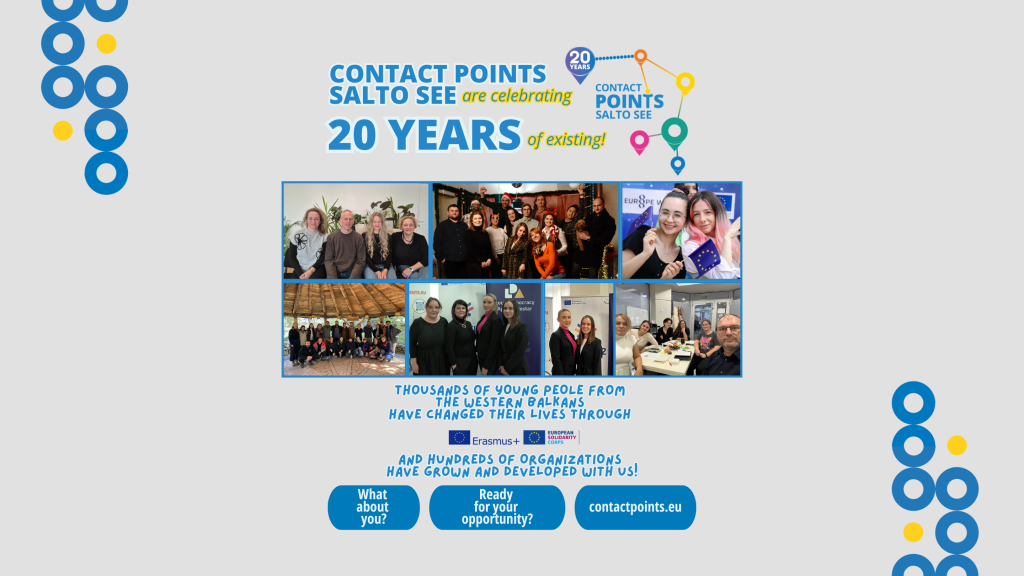
For two decades, the SALTO SEE Contact Point Network has been supporting young people, organisations and communities across the Western Balkans in accessing European Union programmes and opportunities.
Through the Erasmus+ Programme and the European Solidarity Corps, Contact Points help turn opportunities into real experiences, from youth exchanges and volunteering to partnerships, training and long-term cooperation.
A network built on people and local support
The Contact Points operate in Albania, Bosnia and Herzegovina, Kosovo, Montenegro and Serbia, acting as a bridge between European Union programmes and local communities. All Contact Points operate within and in close cooperation with SALTO SEE, which coordinates and supports the network at regional level.
They provide:
• information and guidance on Erasmus+ and ESC opportunities;
• support to organisations in developing projects and partnerships;
• mentoring for young people and youth workers;
• outreach activities, trainings and consultations.
Their role is to make European Union programmes accessible, understandable and usable at local level.
Meet the Contact Points behind the network
Across the region, six organisations currently act as Contact Points, each contributing with their expertise, experience and local impact:
• ADP-Zid (Montenegro) – active since 1996, Contact Point since 2006, supporting youth participation, NGOs and community development through Erasmus+ and ESC.
• Beyond Barriers Association (Albania) – founded in 2004, Contact Point since 2011, focused on inclusion and equal opportunities for young people.
• GAIA (Kosovo) – promoting peacebuilding, environmental awareness and participation through Erasmus+ and ESC.
• Youth Center John Paul II (Bosnia and Herzegovina) – strengthening youth engagement through the European Solidarity Corps and volunteering.
• LDA Mostar (Bosnia and Herzegovina) – Contact Point since 2025, supporting organisations and institutions in accessing European opportunities.
• Svetlost (Serbia) – active in international cooperation since 2005, ESC Contact Point since 2024, promoting volunteering and youth development.
Together, they represent a network that combines local knowledge with European Union programmes and opportunities, making programmes more accessible to diverse target groups.
Why this network matters
Over the past 20 years, the Contact Points Network has:
• supported thousands of young people in participating in international experiences;
• helped organisations develop projects and partnerships across Europe;
• strengthened youth work and non-formal education in the region;
• contributed to building cooperation, solidarity and active citizenship.
As highlighted throughout the network’s development, Contact Points have become a key link between European Union programmes and local realities in the Western Balkans.
Looking ahead
Celebrating 20 years is not only about reflecting on achievements, but also about looking forward.
The network continues to:
• support new generations of young people;
• empower organisations and institutions;
• strengthen regional cooperation;
• create opportunities for learning, mobility and engagement.
Whether you are a young person, organisation or institution, your entry point to European Union programmes is closer than you think.
Get involved
If you want to:
• join a project;
• volunteer abroad;
• develop partnerships;
• or learn more about Erasmus+ and the European Solidarity Corps.
👉Reach out to your local Contact Point and start your journey.