


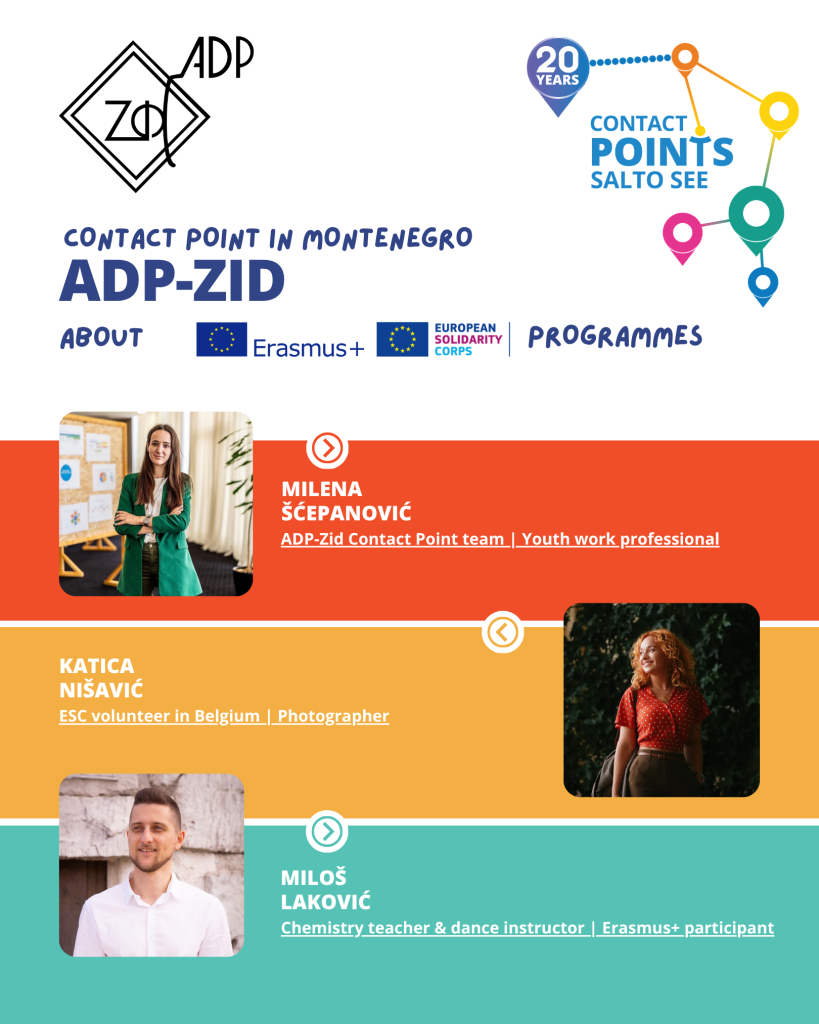
🇲🇪 ADP-ZID – Montenegro
ADP-ZID is a non-governmental organization founded in 1996 in Montenegro. Since 2006, it has been serving as a Contact Point for the Erasmus+ programme, and later for the European Solidarity Corps (ESC). Their vision is a society of equal and responsible citizens, oriented towards democracy, social values, and community development. Through participation, innovation, creativity and solidarity, they have been supporting young people, organizations and communities for over 15 years.
🧑 Katica Nišavić – Profile 3 (Participant / Volunteer)
Katica Nišavić is an artist from Montenegro who participated in an ESC project in Belgium, where she spent a year at an art residency. Her journey began in 2018 through the local organization FORUM MNE, and continued with the support of ADP-Zid.
1. Could you briefly introduce yourself and share how you first came into contact with the SALTO network and the programmes it supports (Erasmus+/ESC)? What role did they play in your personal and professional development?
It was in 2018, while I was involved in the local NGO FORUM MNE as an intern, that I first came into contact with the SALTO network. Shortly after, I attended a short-term project in Spain. In 2019, I spent a year in Belgium doing a long-term European Solidarity Corps project, which transformed me on many levels and had a lasting impact on who I am today.
2. Take us back to the beginning – how did you first hear about Erasmus+ or ESC, and what made you decide to apply?
I first heard about it from my sister, who did her ESC project in Croatia. I immediately became curious and motivated to do something similar. I started researching projects that matched my artistic interests and eventually found one at an art residency in Belgium.
3. How did the Contact Point or sending organisation support you in that moment?
My sending organisation was ADP ZID, and Mirela was the person I communicated with the most. They were very helpful throughout the entire process, from applying and handling visa procedures to organizing my travel to the country where I was going to carry out the project.
4. If you had to describe your experience with the CP or the sending organisation in a few words, what would you say?
I would describe it as understanding, empathetic, and supportive.
5. Which moment during the programme most clearly showed you the value of the experience, and why?
It was during the team-building activities with other volunteers I met throughout the projects. Their open-mindedness and inspiring eagerness for new experiences really showed me the true value of the programme.
6. What changed for you professionally, and what changed personally, after participating in the programme?
Professionally, it enriched me with photography knowledge and expanded both my hard and soft skills. Personally, it encouraged me to keep stepping out of my comfort zone whenever I have the opportunity.
7. Is there something you are doing today, or a version of yourself you’ve become, that wouldn’t exist without this opportunity?
Absolutely. One of my biggest dreams came true — I had my first solo photography exhibition, initially in Podgorica. Later, I was invited to Belgium, to the same art residency, to showcase my work there as well.
8. Imagine your best friend is unsure about applying. What would you tell them from the heart?
Step out of your comfort zone — you will never regret it. Be bold about what you want, and you won’t even be able to count all the benefits that will come from it.
🧑 Miloš Laković – Profile 2 (Professional / Educator)
Miloš Laković is a chemistry teacher in three schools in Montenegro and a dance instructor in Podgorica. Through Erasmus+ and ESC programmes, he improved his communication, organizational and teamwork skills, and today actively passes on his gained knowledge through work with young people.
1. Could you briefly introduce yourself and describe your professional journey in connection with the SALTO network and its programmes?
Hello, my name is Miloš Laković. I work as a chemistry teacher in three schools in Montenegro, and I am also a dance instructor in a dance school in Podgorica. My participation in SALTO programmes has contributed greatly to my professional and personal development. Through these experiences, I improved my communication skills, developed my personality, and strengthened my organisational and teamwork abilities.
2. How did you move from your first contact with the programmes to actively working with them today?
My first contact with the Erasmus+ and ESC programmes was through ADP-Zid, an organisation I had already been cooperating and volunteering with for some time. They became my contact point for an Erasmus project in Spain. Before my departure, they organised preparation meetings and training sessions, and after I returned, they also provided opportunities for me to lead workshops and share the knowledge and experiences I had gained. Following my Erasmus experience, I became involved in several other youth exchanges and international projects outside Montenegro.
3. How did you first come into contact with Erasmus+ or ESC, and what role did the CP play in that process?
The Contact Point encouraged me through various activities to participate in Erasmus+ projects and youth exchanges. They introduced me to how the programme works, explained the opportunities available, and gave me the motivation and support I needed before starting my Erasmus journey.
4. What did the CP help you understand or overcome when you were just starting?
The CP helped me understand how the programmes function and supported me throughout the entire process. Many of the activities and initiatives I organised after my exchanges would not have been possible without their support, resources, and promotion of the ideas I wanted to implement.
5. Can you share an example of a project or initiative that would not have been possible without the CP’s support?
All the activities I experienced through Erasmus+, including the preparation trainings, the programme itself, and the follow-up initiatives afterwards, helped me become more confident and develop many important skills. One of the biggest improvements was my language and communication skills, which later helped me start working in an international school environment.
6. In what ways have Erasmus+ and ESC influenced your professional path or the way you work today?
Erasmus+ and ESC have had a strong influence on both my professional and personal life. They helped me become more open-minded, adaptable, and confident when working with different groups of people. Today, I apply many of the methods, communication approaches, and organisational skills I learned through these programmes in my work as both a teacher and dance instructor.
7. What specific skills, knowledge, or networks do you use today thanks to these programmes?
Thanks to these programmes, I improved my communication and presentation skills, teamwork abilities, leadership, and project organisation. I also built an international network of friends and colleagues, which continues to open new opportunities for cooperation, learning, and professional growth.
8. When young people or organisations approach you for the first time, what are they usually curious or unsure about?
Young people are often unsure about how the time spent on these programmes will contribute to their personal and professional development. Many of them are students with university obligations, so they are also concerned about whether they will be able to balance all the programme activities with their studies and responsibilities.
9. What would you say to young people and organisations in the Western Balkans who are still hesitant about getting involved?
I would tell them not to overthink too much, but to give themselves a chance and be brave enough to join the programme. They will gain valuable experience that will help them grow both personally and professionally. The whole process, with all its challenges and successes, is exactly what makes these programmes special, and I am sure they will enjoy the journey.
🧑 Milena Šćepanović – Profile 1 (Strategic / Senior Voice)
Milena Šćepanović is a long-time member of ADP-Zid, where through various roles she has contributed to the development of youth work and international cooperation in Montenegro. Through her work with Erasmus+ and ESC programmes, as well as the SALTO network and Contact Point mechanisms, she has worked on empowering young people and organisations to become active participants in their communities.
1. Could you briefly introduce yourself, describe your role within your organisation, and explain your connection with the SALTO network and the programmes implemented through it? How have you contributed to the development of organisations, young people, and the youth sector in your country through these programmes?
My name is Milena Šćepanović and I have been part of ADP-Zid for many years, where through different roles I have had the opportunity to contribute to the development of youth work and international cooperation in Montenegro. Through my work, I have been closely connected with the Erasmus+ and ESC programmes, as well as with the SALTO network and Contact Point mechanisms that made these opportunities more accessible to young people and organisations in our region.
Over the years, through mobility projects, trainings, partnerships and support for organisations, we worked on empowering young people to become active participants in their communities, gain new knowledge, experiences and international connections. At the same time, we contributed to strengthening the capacities of civil society organisations and the professionalisation of youth work in Montenegro.
Through ADP-Zid and cooperation with the SALTO network, we had the opportunity to be part of a process that enabled many young people, often for the first time, to travel, learn, volunteer and believe that they can actively contribute to society.
2. Looking back, how would you describe youth work and international cooperation in your country before, and how does it look today thanks to the SALTO network and the CPs?
When we look back 20 or 30 years ago, youth work in Montenegro was much less recognised and developed than it is today. There was a lot of enthusiasm, but fewer opportunities, fewer international partnerships and limited access to programmes that would allow young people to learn, travel and connect with peers from other countries. Organisations often worked in isolation and with much less support for capacity building.
Today, the situation is significantly different, and I believe that SALTO and organisations acting as Contact Points have played a very important role in this change. Through these programmes, space was created for continuous international cooperation, exchange of knowledge and the professionalisation of youth work. Organisations have become stronger, more connected and more visible, while young people now have many more opportunities to participate in international projects, trainings, volunteering and decision-making processes.
The role of CPs in the Western Balkans has been especially important because they acted as a bridge between European programmes and local organisations and young people. People had someone they could turn to, ask questions, receive support and encouragement from. This contributed to international cooperation no longer being a privilege of a small number of organisations, but an opportunity accessible to a much wider circle of young people and organisations in the region.
3. How has the Contact Point concretely contributed to the development of your organisation and the youth sector in your country?
The Contact Point played a very important role in the development of our organisation, but also of the youth sector in Montenegro in general. Through continuous support, information sharing and mentoring, it enabled organisations to better understand Erasmus+ and the European Solidarity Corps programmes and gain the confidence to engage in international projects.
For ADP-Zid, which has been the Contact Point for the Erasmus+ programme since 2006, it was particularly significant that through cooperation with the CP we had access to quality information, trainings, partnerships and spaces for exchanging experiences with organisations from the region and across Europe. This contributed to strengthening our capacities, developing new youth programmes and creating long-term international cooperation.
On a broader level, the Contact Point contributed to youth work becoming more visible and recognised as an important part of social development. It encouraged many smaller and less developed organisations, as well as young people, to engage in different programmes even when they had no previous experience. This accessibility of support and the feeling that there was someone who understood the local context and organisations’ needs was crucial for the development of the entire sector.
4. What is the most significant change that Erasmus+ and ESC have brought to young people and organisations with the support of the CP?
I believe that the most significant change brought by Erasmus+ and ESC to young people and organisations is the opening of space for personal and professional development, but also the feeling of being part of a wider European community. Thanks to these programmes, young people had the opportunity to travel, meet other cultures, develop competencies and gain the confidence to actively contribute to their communities.
For many young people from Montenegro, this was their first international experience that changed their perspective, opened new friendships and professional opportunities. At the same time, organisations became stronger, more professional and more connected with partners across Europe through these programmes.
The support of the Contact Point was especially important because it made these opportunities more accessible and understandable to organisations and young people at the local level. The CP was not only an information service, but also a partner that provided support and a sense that organisations could successfully develop international projects and long-term cooperation.
5. Can you share one concrete example where the CP made a real difference for a community and organisation?
One concrete example where the Contact Point made a real difference was the support provided to smaller local organisations that had no previous experience with international projects. Through workshops, mentoring and direct support in project preparation, many of these organisations managed to participate in Erasmus+ programmes for the first time.
I remember one organisation from a smaller local community that had great motivation to work with young people, but lacked the knowledge and contacts needed to develop international projects. With the support of the CP, they managed to find partners, prepare a project and involve young people from their community in an international exchange. This experience changed not only the organisation, but also the young people themselves, who for the first time had the opportunity to travel, meet peers from other countries and gain new knowledge and self-confidence.
Such examples show how important local support is and how a Contact Point can become a driver of development for communities that otherwise might not have access to these opportunities.
6. Why does it matter to have a local Contact Point – someone people can talk to, ask questions, and rely on?
Because it means a lot to people to have someone they can directly turn to and speak with in their own language and within their own context. EU programmes can sometimes seem complicated, especially for organisations applying for the first time. A local CP makes these opportunities accessible, understandable and achievable.
It makes a huge difference when there is someone who understands the local realities, challenges and needs of organisations and who can guide them through the whole process.
I believe that this human aspect is one of the greatest values of the CP network. People do not only need programmes and administration — they also need support, trust and the feeling that they can rely on someone.
7. If you had to describe the importance of the CP network for the Western Balkans in one sentence, what would you say?
Creating space for young people from the region to learn, cooperate, travel and together build a more open and connected society.
8. Looking ahead, what would you love to see the CP network achieve in the next 20 years?
In the next 20 years, I would love to see the CP network continue to be a strong space of connection and support for organisations and young people in the Western Balkans, regardless of the fact that some countries may become members of the European Union in the meantime.
It is important not to lose the spirit of cooperation, solidarity and mutual understanding that has been built through these programmes over the years. I believe the CP network can play an even more important role in empowering young people to remain active in their communities, continue developing quality youth work and keep connecting the region through shared values, partnerships and learning opportunities.
🌐 Contact (Website & Instagram): zid.org.me / adpzid