


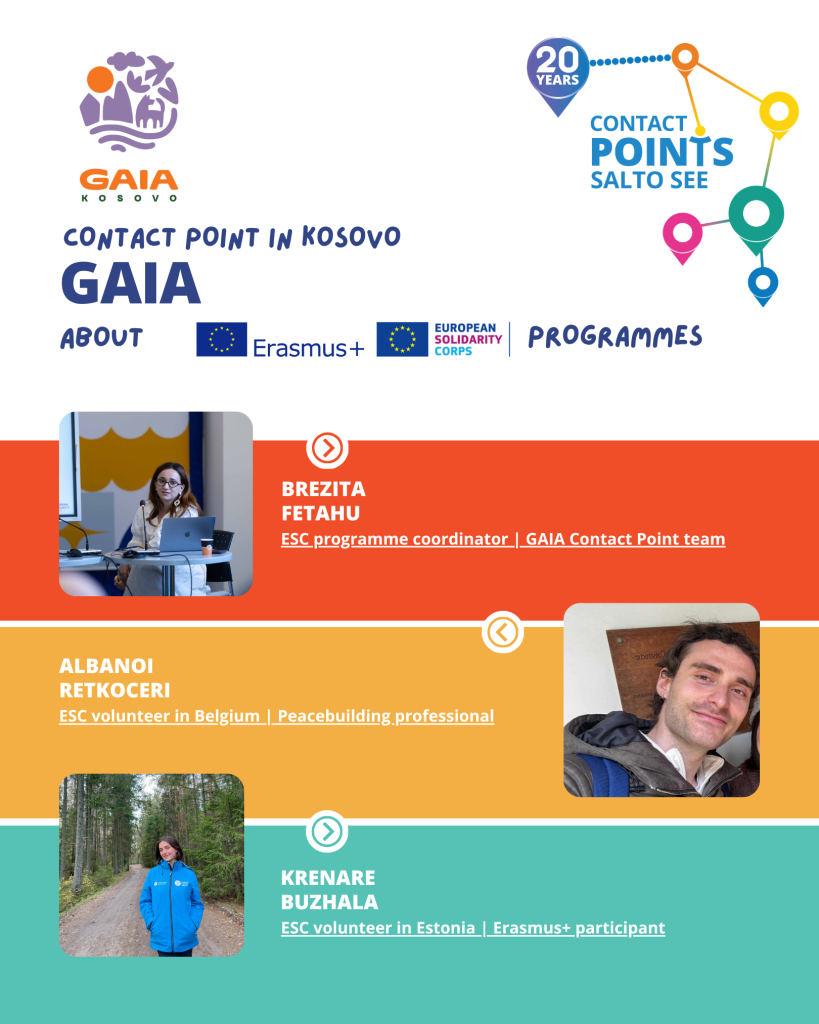
GAIA works towards peace by creating spaces and opportunities where people from various backgrounds can share experiences. They envision restoring and creating relationships between people and nature. As a Contact Point, they work closely with SALTO SEE to promote Erasmus+ and ESC programmes to young people and organisations in Kosovo. Through their work, they support hundreds of young people, youth workers and organisations participating in these programmes.
🧑 Krenare Buzhala – Profile 3 (Participant / Volunteer)
Krenare Buzhala is from Kosovo. Through Erasmus+ and ESC programmes, she participated in short-term and long-term volunteering projects in Turkey and Estonia. These experiences shaped her view of the world, made her more independent and open, and helped her discover her potential in professional environments.
1. Could you briefly introduce yourself and share how you first came into contact with the SALTO network and the programmes it supports (Erasmus+/ESC)? What role did they play in your personal and professional development?
I am Krenare Buzhala, coming from Kosovo, where opportunities for many international projects were very limited. During my studies, I started becoming more active whenever I could. For the first time, I became familiar with Erasmus+ when I applied for my exchange semester in the UK.
As for ESC, it is a more recent experience. I have done both a short-term and a long-term volunteering project. I started with my short-term in Ankara, Turkey, but this time I would prefer to speak more about my long-term volunteering. In March 2023, I travelled to Estonia where I did my long-term project.
Both of these experiences, together with Erasmus+, have played a major role in my life, both personally and professionally. They shaped my ideas and cultural awareness much more than I could have done by staying only in my home country.
2. Take us back to the beginning – how did you first hear about Erasmus+ or ESC, and what made you decide to apply?
I first heard about ESC later during my studies. Even though I knew about it, I was a bit skeptical about applying because I didn’t know many people who had applied or participated. Around 2020, I started seeing more open calls, and something inside me knew that I wanted to try this programme and experience something different.
3. How did the Contact Point or sending organisation support you in that moment?
When I first made contact with Gaia Kosovo for my volunteering project in Estonia, even before applying, I was welcomed in the best way possible. They offered me support and information, making it easier for me to start a journey I wasn’t fully sure I wanted to take.
Since I was already part of a short-term volunteering and had experienced being away from home, Gaia really felt like a warm hug from my home country. Their support never stopped and it always came at the right time.
4. If you had to describe your experience with the CP or the sending organisation in a few words, what would you say?
Fun, friendly, therapeutic, supportive, a safe space to be myself and talk about my journey. All my worries were talked about there. I had a contact person who truly listened to me and gave me advice when I needed it most.
5. Which moment during the programme most clearly showed you the value of the experience, and why?
For me, the moment that clearly showed the value of the experience came after a few months into my project. The beginning was a bit tough. Being far away from home, I felt lonely and couldn’t concentrate properly at first.
After some months, when I started connecting more with the people I was working with, creating activities and becoming more involved in my work, I realized how much I was growing. That was the moment I understood the real value of the experience.
6. What changed for you professionally, and what changed personally, after participating in the programme?
I changed both personally and professionally after every such experience. For me, it was another way of experiencing a culture very different from the ones I was used to. It helped me become more independent, believe in my own decisions, and live in a place that gave me new perspectives on life.
Professionally, I changed a lot in my work routine and gained many valuable skills. I worked in fields I wasn’t familiar with before, which helped me grow in ways I did not expect.
7. Is there something you are doing today, or a version of yourself you’ve become, that wouldn’t exist without this opportunity?
There is definitely a version of myself today that wouldn’t exist without this opportunity. I am more confident, more open-minded, and less afraid of stepping into the unknown. I take more initiative now and trust myself more in professional environments. Without these experiences, I don’t think I would have discovered this side of myself.
8. Imagine your best friend is unsure about applying. What would you tell them from the heart?
If my best friend was unsure about applying, I would tell them from the heart that you will never feel 100% ready. Growth does not happen in comfort. It happens when you challenge yourself. Even if it feels scary at first, it might become one of the most meaningful experiences of your life, just like it did for me.
🧑 Albanoi Retkoceri – Profile 3 (Participant / Volunteer)
Albanoi Retkoceri is from Kosovo. He first learned about the European Solidarity Corps through a random Facebook post, after which he started researching and discovered the volunteering platform. His volunteering experience was incredibly valuable and had a strong impact on his career, opening his world and enabling him to work in an international environment.
1. Could you briefly introduce yourself and share how you first came into contact with the SALTO network and the programmes it supports (Erasmus+/ESC)? What role did they play in your personal and professional development?
My name is Albanoi Retkoceri and I am from Kosovo. I first learned about the European Solidarity Corps through a random Facebook post, but then I started researching more and exploring the volunteering platform online. My volunteering experience has been incredibly valuable and has had a strong impact on my career. It was the first time I worked in an international environment, and I learned so much about different cultures, perspectives, and ways of working. It really opened my world.
2. How did you first hear about it?
At first, I heard about it from people who had already participated. Seeing their experiences made me curious, so I decided to look for opportunities myself and explore what was possible.
3. How did the Contact Point or sending organisation support you in that moment?
My sending organisation supported me a lot. We had meetings before my departure and they made sure I felt prepared and informed. They were always available to help, whether it was with logistics or emotional support. I am especially grateful to my contact person, who was very supportive and reassuring throughout the process.
4. If you had to describe your experience with the CP or the sending organisation in a few words, what would you say?
I would describe the relationship as supportive and constructive. Even while I was volunteering in Belgium, we had regular check-ins to reflect on how things were going and what I was learning. It made me feel accompanied, not alone.
5. Which moment during the programme most clearly showed you the value of the experience, and why?
Taking part in the International Committee meeting was an incredible experience. For the first time, I had the responsibility of covering a major event from a communication perspective. It was challenging, but it also showed me that I was capable of contributing in a professional international setting. That moment really made me realise the value of the whole experience.
6. What changed for you professionally, and what changed personally, after participating in the programme?
Professionally, I became more confident in my skills and more open to new opportunities. Personally, I learned a lot about myself — what I want to do in life and the kind of person I want to become. The experience helped me grow in ways I didn’t expect.
7. Is there something you are doing today, or a version of yourself you’ve become, that wouldn’t exist without this opportunity?
Yes. I am still working in the peacebuilding sector today, and I truly believe that this opportunity played a key role in shaping that path.
8. Imagine your best friend is unsure about applying. What would you tell them from the heart?
I would tell them from the heart that it is an experience that should not be missed. It can be challenging at times, but it is deeply fulfilling. I am genuinely grateful for it, and I would choose it again without hesitation.
🧑 Brezita Fetahu – Profile 2 (Professional / Coordinator)
Brezita Fetahu is from Kosovo. She heard about SALTO in her early twenties through volunteering and various training courses abroad. During her ESC long-term volunteering year, she became more familiar with the network and the programme itself. Today she works with SCI Gaia Kosovo, where she organizes and facilitates info sessions for the ESC programme and supports short/long-term volunteers going abroad.
1. Could you briefly introduce yourself and describe your professional journey in connection with the SALTO network and its programmes? How did you move from your first contact with the programmes to actively working with them today?
My name is Brezita Fetahu and I am from Kosovo. I heard of Salto in my early 20s while volunteering and attending different training courses abroad. During my volunteering year (ESC LONG TERM VOLUNTEERING) I got more familiar with the network and the program itself. Currently, I am working with SCI Gaia Kosovo and one of my tasks is to organize and facilitate infosessions for the ESC programme. I also support short/long term volunteers who go abroad.
2. How did you first come into contact with Erasmus+ or ESC, and what role did the CP play in that process?
First, I started volunteering locally and then when I got in Uni I heard more about Erasmus+ and ESC. In my last year of studies I did an Erasmus+ Exchange semester in England. Upon my return, I got more curious about volunteering abroad and I was looking for opportunities. I contacted CP and they informed me on the process of application.
3. What did the CP help you understand or overcome when you were just starting?
Contacting CP in this regard was very helpful. They explained to me in detail the ESC and the opportunities of the program through different meetings. This process helped me a lot in the beginning, so that I could apply for long term volunteering.
4. Can you share an example of a project or initiative that would not have been possible without the CP’s support?
The meetings I had made it easier for me to make a decision on the project I wanted to volunteer. So without their support, it would probably take me longer to understand the program and apply for it.
5. In what ways have Erasmus+ and ESC influenced your professional path or the way you work today?
ESC long term volunteering experience helped me grow a lot professionally and it inspired me a lot to continue working on this matter. I personally love to see more young people experiencing this program once in their lifetime so I continue to promote it to everyone who would like to try it.
6. What specific skills, knowledge, or networks do you use today thanks to these programmes?
Thanks to these programmes, I gained a lot of new skills, I learned a new language, opened my horizons and network and above all I shared different cultural knowledge. I made a lot of new friends which I am very thankful to continue these friendships from people all over the world.
7. When young people or organisations approach you for the first time, what are they usually curious or unsure about?
During the time I facilitate infosessions, people are mostly curious about how volunteering life will look like in a different country. This comes with some uncertainty from their side as they are not sure about changing their comfort zone, learning a new language and adapting to a new culture.
8. What would you say to young people and organisations in the Western Balkans who are still hesitant about getting involved?
I would definitely recommend doing at least a short term volunteering experience and don’t let your fears stop you from experiencing this. No matter how difficult it might seem at the moment, once you do it and looking back you will be very fulfilled and happy.
🌐 Contact (Website & Instagram): gaiakosovo.org / gaiakosovo